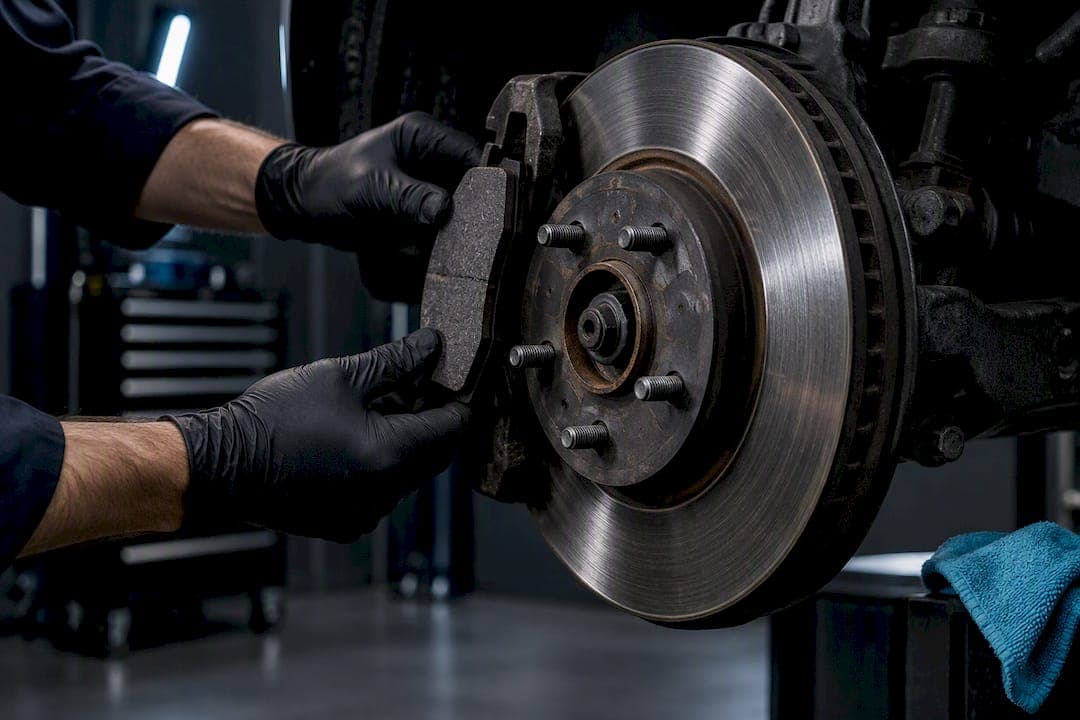
Replacing brake pads alone typically costs $100 to $300 per axle, or roughly $200 to $600 for a full front-and-rear job. Add rotors and that range moves to about $250 to $500 per axle, or $500 to $1,000 across two axles. Your vehicle, parts quality, and local labor rates all shift the final number, but if your rotors are worn, grooved, or causing vibration, replacing them along with the pads is the safer call.
TL;DR:
- Replacing brake pads alone costs between $100 and $200 per axle for compact cars, but can reach over $300 per axle for luxury and performance vehicles.
- Labor and parts costs vary significantly based on vehicle size, hardware condition, and whether rotors are replaced or resurfaced, with independent shops generally charging less than dealerships.
- Upgrading to new rotors is recommended when existing ones are worn, warped, or below minimum thickness, as resurfacing often provides limited long-term value.
- A comprehensive brake job includes parts, labor, hardware, lubricant, and possible additional fees, with clear written estimates vital for fair comparison.
- Doing your own brakes can save money if you already own necessary tools, but complex vehicles with electronic parking brakes or corroded hardware usually require professional service.
Table of Contents
- 1. Typical price ranges for pads-only versus pads and rotors
- 2. What you’re actually paying for in a brake job
- 3. What actually pushes your brake quote up or down
- 4. When rotors should be resurfaced instead of replaced
- 5. Should you replace your own brakes or pay a shop?
- 6. How to get a written estimate you can actually compare
- 7. What a transparent brake inspection and estimate looks like
- What actually matters when you’re pricing a brake job
- Book a brake inspection with Chapman’s Automotive
- Sources
- FAQ
1. Typical price ranges for pads-only versus pads and rotors
The dollar figures above hold up across most mainstream vehicles, but where your car falls in that range depends on size, weight, and how the brakes are engineered. A compact sedan with small rotors and simple single-piston calipers sits at the low end. A three-quarter-ton pickup with towing brakes sits at the high end, sometimes above it.
Here’s how the ranges typically break out by vehicle type:
- Compact cars and small sedans: pads-only often lands near $100 to $200 per axle; pads and rotors together run $250 to $400 per axle.
- Midsize SUVs and crossovers: pads-only typically costs $150 to $250 per axle; pads and rotors run $300 to $450 per axle given larger rotor diameters.
- Half-ton pickups: expect $200 to $300 per axle for pads-only and $350 to $500 per axle with rotors, reflecting heavier hardware and bigger brake components.
- Luxury and performance vehicles: pads-only can exceed $300 per axle, and pads with rotors frequently run $500 or more per axle due to premium materials and multi-piston calipers.
A useful real-world data point comes from RepairPal’s estimator for a 2025 Honda CR-V, a common midsize SUV, which lists pad replacement averaging $260 to $317, split into roughly $138 in parts and $122 to $179 in labor. That example lines up closely with the midsize SUV range above and shows how parts and labor split on a typical job.
Whole-vehicle totals matter more than most owners realize when budgeting. If a shop quotes pads and rotors on both front and rear axles, you’re looking at the per-axle rotor figure doubled, not the pads-only number doubled. Confusing the two is the most common reason estimates seem to jump between quotes for what sounds like the same job.
Kelley Blue Book’s brake-repair guidance puts average pad replacement closer to $150 per axle for many common vehicles, a helpful midpoint if your car doesn’t fit neatly into the categories above. KBB also notes that dealer shops tend to charge more than independent shops for the same parts and labor, which explains a chunk of the spread you’ll see between quotes.
2. What you’re actually paying for in a brake job
A brake job bill breaks into three buckets: parts, labor, and a handful of smaller charges that catch owners off guard. Understanding each one makes a quote easier to evaluate and harder for anyone to pad without you noticing.
Parts typically include:
- Brake pads: $35 to $150 per axle depending on material (ceramic, semi-metallic, or organic).
- Rotors: $60 to $150 per axle depending on diameter and vehicle weight class.
- Hardware kit: small hardware such as clips, shims, and anti-rattle springs, usually bundled into the parts total rather than itemized separately.
- Brake lubricant: a small but necessary item for caliper slide pins and pad contact points, often a few dollars folded into labor.
Labor on a standard front or rear axle brake job typically runs 0.5 to 1.5 hours per axle, with shop labor rates ranging widely by region and shop type. A shop charging $100 an hour and a shop charging $170 an hour can produce a $100 difference on the same job, even using identical parts.
Pads and rotors together commonly total $250 to $500 per axle, according to AAA’s brake repair guidance, which reflects combined parts and labor for a typical passenger vehicle. That figure is the single most useful benchmark for comparing quotes across shops.
Watch for ancillary charges that aren’t always disclosed upfront: sales tax on parts, a small disposal fee for old rotors and brake fluid, a brake fluid flush if your fluid is contaminated or overdue, and an electronic parking brake reset or scan charge on newer vehicles with electric calipers. None of these are unreasonable on their own, but they should appear as separate line items, not buried into a round number.

3. What actually pushes your brake quote up or down
Several factors explain why two shops can quote wildly different prices for what sounds like the same repair.
Vehicle-specific factors matter most. Larger rotor diameters cost more in raw material. Heavier vehicles, especially trucks with towing packages, need bigger calipers and thicker rotors rated for more heat and stopping force. Luxury and performance vehicles often use multi-piston calipers, drilled or slotted rotors, and specialty pad compounds, all of which push part prices higher than a standard economy car.
Component condition is the wildcard that turns a routine estimate into a bigger bill. A seized caliper slide pin, rusted mounting hardware, or a corroded caliper bracket adds labor time and sometimes a caliper replacement that wasn’t in the original quote. Vehicles with an electronic parking brake integrated into the rear calipers need a scan tool to retract the caliper piston before the pads come out, which adds both time and equipment requirements a basic shop may not have.
Shop and market factors round out the picture:
- Dealer versus independent shop: dealers typically charge higher labor rates for the same job, a pattern KBB’s brake repair guidance confirms across most markets.
- Local labor rates: a shop in a higher cost-of-living area will naturally quote more per hour, independent of the parts used.
- Coupons and promotional pricing: a bundled “brakes for $99” special often excludes hardware, lubricant, or a proper test drive, so the advertised number rarely matches what you actually pay.
Pro Tip: Ask any shop quoting a promotional price exactly what’s included, hardware and lubricant especially, before you compare it to a full written estimate elsewhere.
4. When rotors should be resurfaced instead of replaced
For years, resurfacing (machining a thin layer off a rotor’s face to smooth it out) was the default move when pads wore down. That’s changed. Most shops now replace rotors outright rather than machine them, largely because modern rotors are manufactured thinner than older designs, and there’s often not enough material left to safely resurface without dropping below the minimum thickness spec, according to R1 Concepts’ explainer on rotor service.

Resurfacing can still make sense in narrow cases: a rotor with only light surface glazing, no measurable warping, and thickness comfortably above the manufacturer’s minimum spec. A technician verifies this with a micrometer, not a visual check, since a rotor can look fine and still be too thin to machine safely.
Here’s why replacement usually wins on value despite the higher upfront cost:
- Safety margin: a new rotor starts at full thickness, giving you the maximum lifespan before the next service is due.
- Matched wear surface: new rotors paired with new pads wear evenly together, reducing the vibration and noise that come from mismatched surfaces.
- Lower long-term cost: resurfacing a marginal rotor often means replacing it again within a year or two anyway, so you pay twice for one job.
If a shop quotes resurfacing on a rotor that’s already at or near minimum thickness, ask to see the measurement. A reputable technician will show you the number, not just tell you it’s “fine.”
5. Should you replace your own brakes or pay a shop?
Brake pad replacement is one of the more approachable DIY jobs on a modern car, but the real cost comparison depends on tools you may not already own.
- Parts cost for DIY typically runs the same $35 to $150 per axle for pads and $60 to $150 for rotors as a shop would charge, since parts prices don’t change based on who installs them.
- Tool costs add up fast if you’re starting from zero: a caliper piston retractor, a floor jack and jack stands rated for your vehicle’s weight, a torque wrench, and in many cases a basic scan tool to release an electronic parking brake before the calipers come off.
- Labor savings are real. Skipping the shop’s $150 to $200 per axle labor charge is the entire financial upside of doing it yourself.
The math favors DIY only if you already own most of the tools or plan to use them again. Buying a full kit for a one-time job often erases most of the savings.
Pro Tip: If your vehicle has an electronic parking brake, rusted caliper hardware, or you’re not confident bleeding brake fluid, that’s a strong signal to let a shop handle it rather than risk a comeback repair.
Corroded bolts that snap, an improperly seated caliper, or a parking brake that won’t release are the kinds of problems that turn a two-hour DIY job into a tow call. Heavier trucks with larger, harder-to-lift wheels and denser hardware raise the stakes further.
6. How to get a written estimate you can actually compare
The biggest source of sticker shock isn’t a high price, it’s an estimate that doesn’t match what you thought you were buying. A few specific requests fix that before work starts.
Ask for a line-item breakdown that separates:
- Parts cost, listed by pad and rotor brand or grade, not just a lump “parts” total.
- Labor hours and rate, so you can see whether the total reflects 0.5 hours or 1.5 hours per axle.
- Hardware and fluid charges, confirming clips, shims, and lubricant are included rather than added later.
- Taxes and fees, including any disposal charge for old rotors or fluid.
- Rotor plan, stating clearly whether rotors are being replaced or resurfaced and why.
Before agreeing to anything, confirm the warranty terms in writing, specifically the duration and mileage covered, and ask whether a test drive and a torque re-check on the wheels are included after the job. A shop that re-torques lug nuts after a short drive is taking a basic safety step seriously.
Red flags worth walking away from include a bundled price with no willingness to itemize it, a refusal to show you the actual parts being installed, and pressure to approve additional work on the spot before you’ve had time to think it over. A shop confident in its pricing has no reason to rush you.
7. What a transparent brake inspection and estimate looks like
Chapman’s Automotive, a family-owned shop in Craig, Colorado, run by J.B. Chapman and his nephew Brad, structures its brake repair process around the same line-item transparency described above.
- Many visits start with a digital inspection with photos, so customers can see the condition of their pads and rotors before agreeing to work.
- Estimates are written and itemized, breaking out parts and labor rather than quoting a flat bundled number.
- Same-day diagnostics can provide answers and repair timelines on the day the vehicle is brought in, avoiding lengthy waits typical of dealerships. Some shops offer loaner cars so a brake job doesn’t leave you without transportation.
- Repairs carry a warranty for several years or miles, which is longer than average for independent shops.
A sample estimate structure lists pads separately from rotors, shows labor hours per axle, calls out hardware and lubricant as their own line items, and includes warranty terms on the invoice. Documented inspections and clear warranties don’t just build trust, they cut down on repeat visits, since you know exactly what was replaced and what’s still covered if a problem resurfaces.
What actually matters when you’re pricing a brake job
Most advice on this topic focuses on hitting the “right” number, as if there’s one correct price for a brake job. There isn’t. A $280 quote and a $420 quote can both be fair, depending on whether one includes rotors, premium pads, and a longer warranty while the other doesn’t.
The bigger blind spot is that owners fixate on the total and skip the breakdown. A shop that shows you photos of your actual worn rotor and itemizes labor hours is giving you more useful information than a shop that simply undercuts a competitor’s number by $50. Price without documentation is a guess dressed up as a quote.
If you take one thing from this guide, prioritize the written, itemized estimate over the lowest sticker price. A slightly higher quote with a real warranty and a documented inspection almost always beats a cheaper one with no paper trail behind it, especially once you factor in the cost of a comeback repair.
— J.B. Chapman
Book a brake inspection with Chapman’s Automotive

If you’re weighing quotes and want a real number instead of a range, Chapman’s Automotive will give you a written, itemized estimate before any work starts, backed by a free digital inspection with photos so you can see exactly what your pads and rotors look like right now.
What to expect at your appointment:
- Same-day diagnostics, so you’re not waiting days just to find out what’s wrong.
- A free loaner car, keeping you mobile while the work gets done.
- A five-year, 50,000-mile warranty on the repair, one of the strongest guarantees available from an independent shop.
The shop services all makes and models, gas or diesel, and serves drivers in the surrounding regional area including nearby towns. Check current pricing and request your line-item brake quote on the auto repair cost guide page.
Sources
The cost ranges and safety guidance in this guide draw on a handful of established automotive references:
- How Much Does It Cost To Replace Brake Pads? | AAA Automotive
- 2025 Honda CR-V Brake Pad Replacement Cost Estimate | RepairPal
- Brake Repair Prices & Cost Estimates — KBB
FAQ
How much are 4 brake pads and rotors?
A full set of pads and rotors on both front and rear axles typically runs $500 to $1,000 total, based on the $250 to $500 per-axle range for pads and rotors combined. Larger vehicles or premium parts can push that figure higher.
Why are brake jobs so expensive?
Brake jobs combine parts (pads, rotors, and hardware) with labor billed by the hour, and both climb with vehicle size, rotor diameter, and local labor rates. Complications like seized calipers or electronic parking brakes add time and sometimes extra parts, which raises the final bill beyond the base estimate.
Can I drive with bad rotors?
Driving on severely worn or damaged rotors reduces braking effectiveness and can cause vibration, pulsation, or noise, and it risks further damage to calipers and pads, according to AAA’s brake guidance. If you notice grinding, shaking through the steering wheel, or a pulsing brake pedal, get the rotors inspected before continuing to drive on them.
How much is a brake job at Jiffy Lube?
Brake job pricing at national chains varies by location and vehicle, and is best confirmed directly with the specific shop before booking. As a general benchmark, expect pricing to fall within the $100 to $500 per axle range that applies across most mainstream shops, whether pads-only or pads with rotors.
Recommended
Questions about your vehicle?
Chapman's Automotive is in Craig, CO — serving the Yampa Valley. Call 970-550-2883 or book online and we'll take a look.