Pre-Purchase Inspection Cost: What You’ll Pay and What You Get

A pre-purchase inspection (PPI) usually costs between $100 and $300, depending on the vehicle, the depth of the inspection and where you live. J.D. Power puts a simple PPI at $100 to $200, and Cars.com cites a RepairPal average of $132 to $200. Diesel trucks, lifted rigs, European models and anything rare can land higher, because the inspection takes more time and more knowledge.
This guide covers what the price should include, what costs extra, how to spot a weak inspection, and how to decide whether it’s worth it on your next used truck or SUV. We’re a family shop in Craig, Colorado, so we also cover what matters for buyers in the Yampa Valley.
TL;DR
- Expect roughly $100 to $300 for a pre-purchase inspection. Specialty, diesel and exotic vehicles cost more.
- The buyer pays. It’s a small cost next to a surprise transmission, engine or turbo bill.
- A real PPI includes a road test, a computer scan for stored and cleared codes, and a written report, ideally with photos.
- Compression and leak-down tests are usually extra and only done if the basic inspection points to a problem.
- A seller who won’t allow an independent inspection is telling you something. Walk away.
Table of Contents
- What a pre-purchase inspection costs
- What a good inspection includes
- What a standard inspection does not include
- Who pays, and when to schedule it
- Is a pre-purchase inspection worth it?
- A used truck or SUV checklist you can run first
- Red flags that should stop the deal
- Our perspective: what we look at on a pre-buy
- Book a pre-purchase inspection in Craig
- How to get the most from your inspection
- FAQ
- Sources
What a pre-purchase inspection costs
Prices vary by shop and by vehicle. Here is what published sources say, so you can tell whether a quote is in the normal range:
| Source | Typical price |
|---|---|
| J.D. Power | $100 to $200 for a simple PPI |
| Consumer Reports | $100 to $150, described as worth it for checking expensive parts |
| Cars.com, citing RepairPal | $132 to $200 average, more for specialist or rare vehicles |
Put those together and the common range is about $100 to $200 for an ordinary car at an independent shop. Add time and expertise, such as a diesel pickup, a lifted 4x4 or a German luxury car, and $200 to $300 or more is not unusual.
Why the price moves
- Vehicle type. A compact sedan takes less time than a one-ton dually with a tow package.
- Depth. A quick safety walk-around costs less than a full inspection with a scan, road test and written report.
- Location. Shop labor rates differ between Denver, Grand Junction and a small town like Craig.
- Add-on testing. Compression tests, leak-down tests and a deeper diesel evaluation take extra shop time.
- Travel. If the vehicle sits in another town, you may pay for mobile service or spend your own time getting it to a shop.
Always ask for the price and the scope before you book. The question to ask is simple: “What exactly is included for that number?”
What a good inspection includes
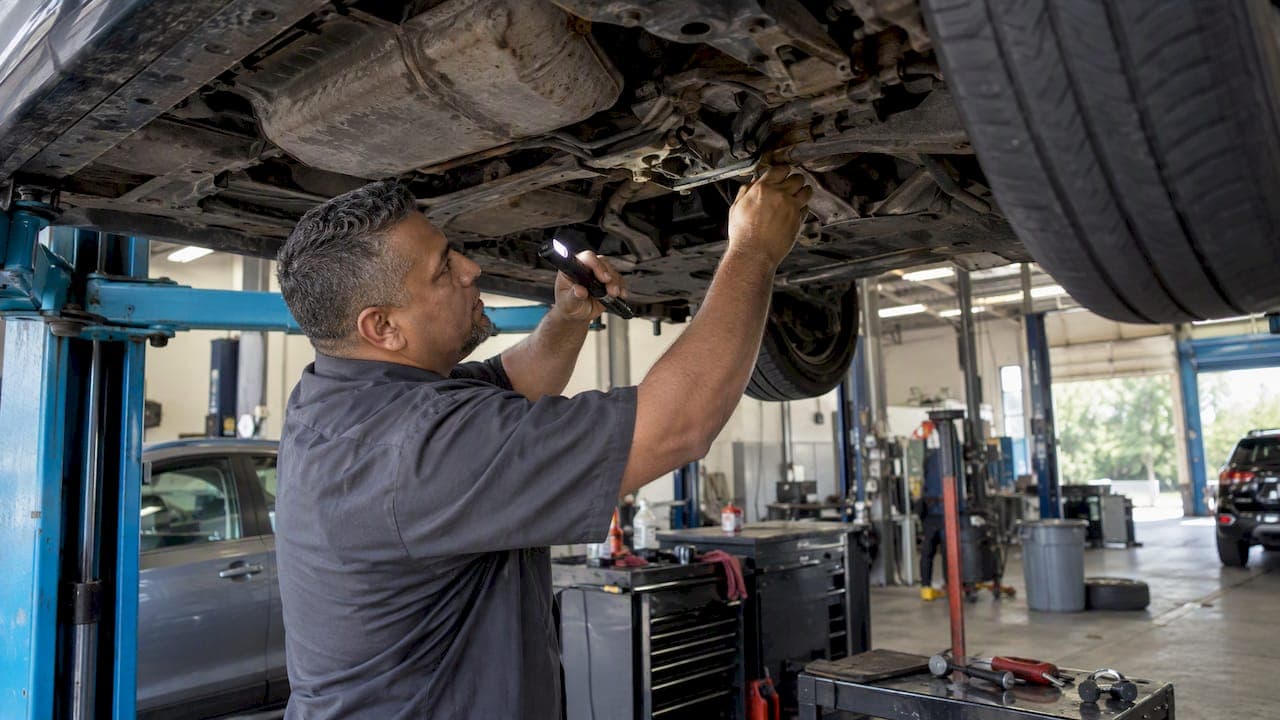
A professional PPI should cover a mechanical and safety assessment, a road test, an OBD (on-board diagnostics) computer scan to look for cleared codes, and a written report, often with photos, so you can see the vehicle’s real condition. That is the standard to hold any quote against.

Here is how that breaks down on the lift and on the road.
On the lift
- Frame, unibody and underbody: rust, bends, repair welds, signs of past accidents
- Brakes: pad thickness, rotor condition, brake lines, leaks
- Suspension and steering: worn bushings, ball joints, tie rods, shocks and struts
- Drivetrain: axle seals, differential leaks, U-joints, transfer case on 4x4s
- Engine bay: leaks, belts, hoses, fluid condition, battery and charging
- Exhaust: leaks, rot, and on late-model diesels, signs of emissions system trouble
- Tires: tread depth, uneven wear that points to an alignment or suspension problem
On the road
- Cold-start behavior and idle quality
- Shift quality, slipping, flaring or harsh engagement
- Brake feel, pulling, vibration
- Steering play and wander
- Noises under load, over bumps and at highway speed
On the scan tool
The scan checks for stored codes, pending codes and whether the computer’s readiness monitors have been recently reset. A seller can clear a check engine light before you arrive. A scan can show that the codes were cleared, which is a reason to ask questions. If you want to understand what a check engine code means and what the next step costs, see our check engine diagnosis cost guide.
What a standard inspection does not include
Buyers often assume a PPI covers everything. It doesn’t. Invasive tests like compression and leak-down testing are normally advanced diagnostics at extra cost, and shops only do them when the basic inspection suggests they’re needed.
Other things a standard inspection won’t do:
- Predict the future. A PPI is a snapshot. It tells you what’s wrong and what’s wearing out. It does not guarantee the vehicle will run trouble-free.
- Replace a history report. Run the VIN through a history service as well. Progressive’s used car checklist recommends checking the vehicle history, service records and open recalls alongside the mechanical inspection.
- Tear down the engine or transmission. If the inspection finds a concern, the next step is a targeted diagnostic, not an assumption.
Who pays, and when to schedule it
The buyer pays for the inspection. Think of it as a small insurance policy against a large repair bill after the sale. Don’t ask the seller to pay, and be wary if a seller offers an inspection from a mechanic of their own choosing.
Timing matters:
- Test drive the vehicle yourself first. Rule out anything you don’t like before spending money.
- Agree to the price in principle, but before signing or handing over money, tell the seller you want an independent inspection.
- Book the shop and confirm the price and scope.
- Ask the seller to leave the engine cold and the vehicle clean. Consumer Reports notes that letting the engine sit for a while before you inspect it helps reveal leaks and cold-start problems.
- Review the written report with the shop before you decide.
A seller who refuses an independent inspection is often considered a significant red flag. A vehicle that’s fine will usually survive an hour on a lift.
Is a pre-purchase inspection worth it?
For most used vehicles, yes. Think about the math:
- A PPI costs about $100 to $300.
- A used truck, SUV or car is often thousands, sometimes tens of thousands, of dollars.
- Private-party sales are usually as-is. Nearly every privately sold used car comes with no warranty, and dealer warranties on used vehicles can be very short.
- Sellers can mask problems, such as steam-cleaning an engine, and the BBB recommends having a mechanic check the car before you sign.
The goal isn’t to find a perfect vehicle. The point is to learn what repairs the car needs before you buy, so you can negotiate or walk away. If a report shows $1,800 of brake, suspension and cooling work, that’s a number you can take to the seller.
A worked example
Say you find a four-year-old pickup from a private seller in another town. The asking price looks fair. The inspection finds worn front brake pads and rotors, a weeping rear axle seal, and a stored code that was cleared the day before. You now have three things:
- A list of repairs you can price before buying
- A reason to ask why the code was cleared
- A negotiating position, or a clean reason to pass
You paid a couple hundred dollars to find that out, not a few thousand after the keys changed hands.
A used truck or SUV checklist you can run first
You can save money by weeding out bad candidates before paying for a professional inspection. Do these checks yourself, and then bring the vehicle in for the real thing.
- Walk around in daylight. Look for mismatched paint, uneven panel gaps and overspray. Those can point to past bodywork.
- Check the tires. Uneven wear can mean alignment or suspension problems. Check the age and the tread.
- Look under the vehicle. Fresh drips, heavy rust or a freshly power-washed engine bay are worth noting.
- Start it cold. Listen for rattles, ticking, rough idle, or smoke at startup.
- Test every switch. Windows, locks, A/C, heat, 4x4 selector, trailer connector.
- Check for warning lights. All dash lights should come on at key-on and go off after start. A light that never comes on is a bad sign.
- Ask for records. Oil change history, major repairs, towing use.
- Run the VIN. Check the history report and open recalls.
On a diesel, add these: ask about maintenance on fuel filters and the regen history, listen for turbo whistle or excessive smoke, and ask whether the truck was tuned or deleted. Those answers affect both value and reliability.
Red flags that should stop the deal
- The seller won’t allow an independent inspection or insists on a specific mechanic.
- The vehicle is warm when you arrive and the seller says it “just got back from a drive.”
- A check engine light was recently cleared, or the readiness monitors haven’t completed.
- Fresh undercoating or a freshly steam-cleaned engine on an otherwise older vehicle.
- Transmission that slips, flares or shifts hard on the road test. If you’re facing this on a vehicle you already own, our guide on diagnosing a slipping transmission before approving a rebuild explains what to ask.
- The title status or history report doesn’t match what the seller said.
Our perspective: what we look at on a pre-buy
We’ve been repairing vehicles in Craig since 1985. J.B. Chapman is the third generation of our family in automotive repair, and his nephew Brad, a partner in the shop, is the fifth generation in the valley. Over that time, we’ve seen what happens when someone buys a truck without a look underneath.
Here is how we think about a pre-purchase inspection:
- The report is the product. The inspection should leave you with a clear, written picture of the vehicle, not a verbal “seems fine.” Every visit at our shop includes a free digital inspection with photos, and a PPI follows the same idea: you see what we see. You can read more about how our digital vehicle inspections work.
- Know the vehicle. We work on all makes and models, American, Asian and European, gas and diesel. That matters on a pre-buy, because a Cummins, a Power Stroke and a Duramax each have their own weak points, and a BMW or Subaru has different ones than a half-ton Chevy.
- Separate urgent from later. A good report sorts problems into things to fix now, things to watch, and things that are normal wear. That helps you negotiate honestly rather than scare yourself out of a good vehicle.
- Price the repairs. If the inspection turns up work, we’ll give you a written estimate so you can compare the real cost of ownership, not just the asking price.
- No pressure. If we find a vehicle isn’t worth buying, we’ll tell you. We’d rather lose a repair job than watch a neighbor buy a money pit.
If you’re driving in from Steamboat Springs, Hayden, Meeker or beyond, call ahead so we can plan time for the vehicle. Same-day looks are something we work hard to offer, and we have free loaner cars and a shuttle available, so waiting on the inspection doesn’t have to stall your day.
— J.B. Chapman
Book a pre-purchase inspection in Craig
If you’re about to buy a used car, truck or SUV, from a private seller or an out-of-town dealer, we can inspect it before you pay. Our pre-purchase inspection page explains what we cover and how to schedule. Call the shop at 310 E Victory Way in Craig and ask for the current price and scope for your vehicle. Repairs we do later carry a five-year, 50,000-mile warranty.

If the vehicle turns out to need work, see our auto repair cost guide for typical prices. For reference, our published ranges include diagnostics at $100 to $150, brake pads at $180 to $350 per axle, wheel alignment at $90 to $150, and a synthetic oil change at $58.97 to $98.97.
How to get the most from your inspection
- Share what you know. Tell the shop the asking price, how you plan to use the vehicle (towing, hunting roads, winter commuting) and any concerns.
- Be there, or get the photos. If you can’t attend, ask for the written report with photos and call to go through it.
- Sort findings by cost. Safety items first, then big-ticket items such as transmission, engine and turbo, then minor wear.
- Negotiate with numbers. Bring written estimates to the seller instead of vague complaints.
- Decide your walk-away line. Set a limit ahead of time, such as total repairs above a certain percentage of the price, and stick to it.
- Plan the first service. Even a good used vehicle benefits from fresh fluids and a baseline. Our oil change service is a sensible first stop after you buy.
FAQ
How much is a pre-purchase inspection?
Most independent shops charge about $100 to $300. J.D. Power cites $100 to $200 for a simple inspection, and specialty vehicles cost more. Ask what’s included before you book.
Who pays for a pre-purchase inspection?
The buyer does. The seller isn’t responsible for it, and an inspection arranged by the seller isn’t independent. Treat the fee as part of the cost of buying.
Can I do my own inspection instead?
You can and should do a first pass: a walk-around, a cold start, a test drive and a history check. But you can’t see brake wear, leaks, frame damage or cleared codes from the driveway. A professional lift inspection and scan finds what you can’t.
What are red flags during a pre-purchase inspection?
Cleared trouble codes, fresh leaks, uneven tire wear, frame or underbody repair, slipping or harsh shifts and a seller who resists the inspection are the big ones. Any of them is a reason to renegotiate or walk away.
Does a pre-purchase inspection include a compression test?
Usually not. Compression and leak-down tests are advanced diagnostics that cost extra, done when the standard inspection suggests an engine problem.
Sources
- J.D. Power: How Do You Get A Pre-Purchase Inspection When Buying A Used Car?
- Cars.com: What Is a Pre-Purchase Car Inspection?
- Consumer Reports: How to Inspect a Used Car
- Capital One Auto Navigator: What Is a Pre Purchase Car Inspection?
- BBB: Buying a used car
- Progressive: Used Car Inspection Checklist
- CarInspections.com: Pre-Purchase Car Inspection Cost
- PPI Auto: Pre Purchase Inspection Cost
Recommended
Questions about your vehicle?
Chapman's Automotive is in Craig, CO — serving the Yampa Valley. Call 970-550-2883 or book online and we'll take a look.