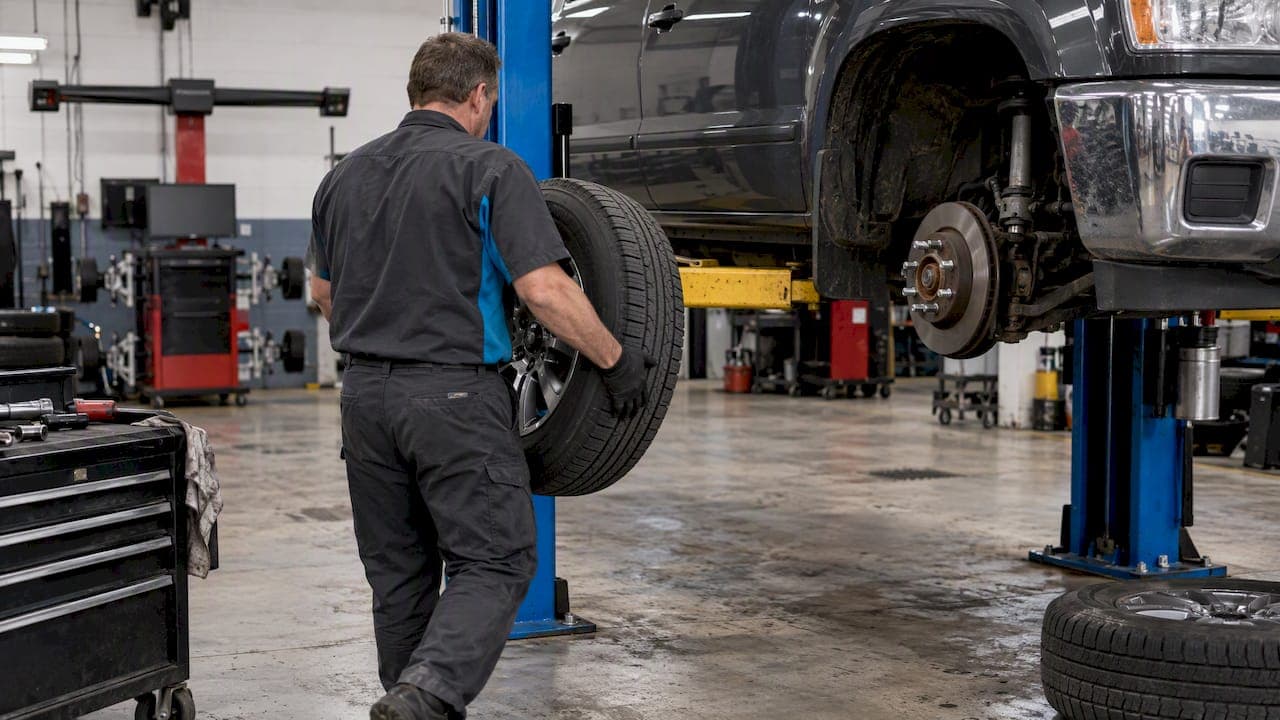
Tire Rotation vs. Alignment: What Each One Does

A tire rotation moves your tires from one position to another so they wear evenly. A wheel alignment adjusts the suspension and steering angles so the wheels point where they should. One is routine maintenance on a schedule. The other is a correction you make when the angles are off. They are not the same service, and one does not replace the other.
This guide explains what each service does, how often you need it, what it costs, where tire balancing fits in, and how to tell which one your vehicle needs today.
TL;DR
- Rotation swaps tire positions to even out tread wear. It is preventive, and the common range is every 5,000 to 8,000 miles.
- Alignment resets suspension angles. Get it checked periodically and any time the truck pulls, the steering wheel sits crooked, or one tire edge wears faster.
- Balancing is a third service. It fixes vibration by adding small weights to the wheel, and it does nothing for wear patterns or steering angles.
- Rotation cannot fix uneven wear that has already started. Correct the cause first, then rotate.
- At Chapman’s in Craig, alignment runs $90-$150 and a tire rotation runs $25-$50.
Table of Contents
- The difference in plain terms
- What a tire rotation does
- What a wheel alignment does
- Where tire balancing fits in
- Is rotation more important than alignment?
- Do you need an alignment after a rotation?
- 2-wheel vs. 4-wheel alignment
- What these services cost in Craig
- Perspective: what we see in the bay
- A simple schedule you can follow
- Before winter: tires, alignment and swaps
- Get it done at Chapman’s in Craig
- FAQ
- Sources
The difference in plain terms
AAA’s tire guide treats these as separate jobs. Rotation moves tires to different positions on the vehicle to promote uniform tread wear. Alignment adjusts the suspension and steering components so the wheels meet the road at the manufacturer’s specified angles.
Here is a way to picture it. Rotation is like switching which shoe takes the heaviest wear. Alignment is like fixing the way you walk. If you walk crooked, switching shoes only spreads the damage around.
| Tire rotation | Wheel alignment | Tire balancing | |
|---|---|---|---|
| What changes | Tire positions | Suspension and steering angles | Weight distribution on the wheel |
| Main benefit | Even tread wear | Straight tracking, even wear, steady steering | Smooth ride, no vibration |
| Type of service | Preventive, on a mileage schedule | Periodic check, or when symptoms show | When vibration shows, and with new tires |
| Typical sign you need it | Front tires wearing faster than rear (or the reverse) | Pulling, off-center steering wheel, edge wear | Shaking in the steering wheel or seat at speed |
| Chapman’s price | $25-$50 | $90-$150 | Ask us for a quote |
What a tire rotation does
Your tires do not wear at the same rate. On a front-wheel-drive car, the front tires steer, drive and carry most of the braking load. On a rear-wheel-drive pickup, the rear tires handle the pulling. Rotation moves each tire to a new position so no single corner takes all of that wear for the life of the set.
The usual interval is every 5,000 to 8,000 miles. Many drivers pair it with an oil change so it never gets skipped. The right pattern and interval depend on your vehicle. AAA’s Via guide points to the owner’s manual as the final word, because drivetrain and tire type change the answer, especially on AWD vehicles.
Rotation is prevention, not a repair
Many drivers believe rotating will fix a tire that is already wearing badly. It will not. According to AAA’s Via guide, once significant uneven wear such as cupping or shoulder wear has set in, rotation is ineffective. You need to address the underlying problem first, such as a worn suspension part or bad alignment. Otherwise you are only moving the problem to other tires.

In practice that means a rotation is the cheapest time to catch a problem. When a tire comes off, we can see how it has been wearing.
What a wheel alignment does
Alignment does not touch the tires. It changes the angles of the wheels relative to the car and the road. The three angles you will hear about are camber (the inward or outward tilt of the wheel), toe (whether the fronts point slightly in or out) and caster (the angle of the steering axis). A technician measures them on an alignment rack and adjusts the suspension to bring them back into the manufacturer’s range.
Potholes, curbs, washboard gravel and ranch roads can all knock those angles out. AAA notes that a hard jolt from a curb or pothole can throw the front end out of alignment and damage tires. In the Yampa Valley, where many drivers cover county roads, frost heaves and gravel to get to work, that is not a rare event.
Signs your alignment is off
- The vehicle drifts left or right on a flat, straight road.
- The steering wheel is crooked when you are driving straight.
- One edge of a tire is wearing faster than the rest of the tread.
- You recently hit a big pothole or curb, or had suspension work done.
Tire Review lists wear concentrated on one edge as a sign of alignment problems. It lists cupping as a sign of imbalance or worn suspension parts such as shocks or ball joints. That second point matters: if the alignment will not hold, the cause may be a worn part, and that is a suspension repair, not an alignment fix.
Where tire balancing fits in
Balancing is the service people mix up with both of the others. A balancing machine measures the lighter and heavier spots in a wheel and tire assembly, and the technician adds small weights to the rim to even them out, as Pirelli explains. The symptom is vibration, usually a shake in the steering wheel or seat at highway speed.
The quick way to separate them:
- Vibration at speed: think balance.
- Pulling or crooked steering: think alignment.
- Even wear on a schedule: that is rotation.
Tire balancing is not part of a standard rotation, and neither is alignment. If your shop offers a package, ask what it includes. We will tell you exactly what is on the estimate before work starts.
One more thing that gets mistaken for a balance problem is a pressure warning on the dash. That is a separate system. If a warning keeps coming back, it is worth understanding what a tire pressure warning code means before assuming it is a wheel issue. Low pressure also speeds up uneven wear, so check it monthly.
Is rotation more important than alignment?
Neither wins, because they protect against different things. If you have to choose based on symptoms:
- No symptoms, tires wearing normally: keep up the rotation schedule.
- Pulling, off-center steering or edge wear: alignment comes first, because rotating misaligned tires only spreads the damage.
- New tires going on: get the alignment checked at the same time so you protect your new tires from day one.
Tire Review calls alignment essential for getting the most out of your tire investment, and that is true for a set of truck tires that can cost well over a thousand dollars. A $90-$150 alignment is small money next to replacing a set early.
Do you need an alignment after a rotation?
No. Moving the tires does not change the suspension angles, so a rotation alone does not call for an alignment. The reverse is also true: an alignment does not rotate your tires.

What the two have in common is the timing. Since the wheels are off during a rotation, it is a good moment to look at tire wear and suspension parts. If the wear pattern shows an alignment problem, we will tell you then, with photos from the inspection, and you can decide.
2-wheel vs. 4-wheel alignment
A 2-wheel (front-end) alignment adjusts only the front axle. AutoZone’s guide says it is typically used on older rear-wheel-drive vehicles with a solid rear axle. A 4-wheel alignment adjusts all four corners and is recommended for most modern vehicles.
For most of what drives around Craig, a 4-wheel alignment is the right choice:
- AWD and 4x4 vehicles: the wheels work together, so mismatched angles can fight each other. See our AWD vs. 4WD in snow guide for how these systems differ.
- Independent rear suspension: most newer cars and SUVs have adjustable rear angles.
- Lifted or leveled trucks: changing ride height changes the angles. If you have a lift kit, an alignment after the install is part of doing the job right.
If your vehicle has a solid rear axle with no rear adjustment, a 2-wheel alignment may be all it needs. Your owner’s manual and the alignment readout will tell us.
What these services cost in Craig
We publish our ranges on our auto repair cost guide so you know the number before you call.
| Service | Chapman’s price |
|---|---|
| Tire rotation | $25-$50 |
| Wheel alignment | $90-$150 |
| Diagnostic (check engine) | $100-$150 |
| Brake pads (per axle) | $180-$350 |
| Synthetic oil change | $58.97-$98.97 |
For context, Tire Review puts the industry average for an alignment at about $107. So $100 is not a crazy number. Where the price lands in our range depends on the vehicle, and every estimate is written down before we start.
If you want to trim the bill, ask about our current specials.
Perspective: what we see in the bay
We have been fixing vehicles in the valley since 1985, and the same pattern shows up over and over. People come in because a tire is worn out on one edge and they have been rotating on schedule the whole time. The rotation was not the problem. The truck was out of alignment, or a tie rod or ball joint had worn loose, and the tires paid for it.
Our advice is simple. Rotate on schedule, and look at the tires every time. Get the alignment checked whenever you put on new tires, hit something hard, or notice the truck drifting. Do not let anyone sell you an alignment to fix a vibration, and do not let anyone sell you a balance to fix a pull.
That is why every visit here includes a free digital inspection with photos. You see what we see: the wear pattern, the worn part, the measurement. Then you decide. If the alignment will not hold because something in the suspension is worn, we say so, and we show you.
— J.B. Chapman
A simple schedule you can follow
The numbers below are starting points. Your owner’s manual overrides all of them.
- Every oil change (or every 5,000 to 8,000 miles): rotate the tires and check tire pressure and tread.
- Every time you buy new tires: get an alignment check.
- After any hard impact: a pothole, curb, or a washed-out ranch road. Get it checked even if nothing feels different yet.
- At the first sign of pulling, vibration or odd wear: book an inspection instead of waiting for the next oil change.
- Before winter: check pressure, tread depth and alignment so your tires are ready for the first storm.
If you struggle to remember maintenance, tie it to the calendar. A fixed routine for car care works for details, and the same habit works for rotations. Pairing your rotation with your oil change is the easiest version.
Before winter: tires, alignment and swaps
Northwest Colorado winters are hard on tires. If you run a separate winter set, the changeover is a natural time to rotate and check the wheels, since the wheels are already off. Our snow tire installation service covers the swap. If you are buying new tires, our tire shop can handle the install and flat repair.
Trailer and RV owners should also note that trailer tires have their own rules. Our guide on bias vs. radial trailer tires covers that.
Get it done at Chapman’s in Craig
We are a family-owned shop at 310 E Victory Way in Craig, working on all makes and models, gas and diesel, since 1985. Whether you need a rotation, a 4-wheel alignment or just a second opinion on a tire that is wearing strangely, we start with a free digital inspection with photos. Free loaner cars and a shuttle are available, and our repairs carry a 5-year, 50,000-mile warranty.
If the problem turns out to be worn parts, our suspension and steering team can handle it under the same roof. Start with our tires and wheel alignment page to book. Driving over from Steamboat Springs or Hayden? Call ahead and tell us about the symptoms, and we will tell you what to expect.
FAQ
Should I do a tire rotation and alignment at the same time?
It is convenient, but only the alignment is driven by symptoms. Rotate on schedule, and add an alignment when you have new tires, have hit something hard, or see pulling or edge wear. If we are already inspecting the wheels, we can tell you whether an alignment is worth doing that day.
Is $100 a lot for an alignment?
No. The industry average is about $107, and our alignment range is $90-$150 depending on the vehicle. The cost of skipping it is usually worn-out tires sooner than they should be.
Does a tire rotation include balancing?
Not by default. Rotation moves the tires to new positions. Balancing adds small weights to the wheel to stop vibration, and it is a separate service. Ask for it if you feel shaking at speed, or when new tires go on.
Can I rotate my own tires?
Yes, with the right tools and a safe way to lift the vehicle. Tire Review notes that rotation is the simple one. Balancing and alignment need machines most garages do not have, so leave those to a shop.
Do I need a 4-wheel alignment on my AWD or 4x4?
Usually yes. A 4-wheel alignment is recommended for most modern vehicles, and AWD and 4x4 systems are sensitive to uneven angles and tire wear. Check your owner’s manual and let us look at the specs for your vehicle.
Sources
- AAA, Be Tire Smart guide
- AAA Via, When Should You Rotate Your Tires?
- Tire Review, Tire Shop Services Making You the Most Money
- Pirelli, how do I know if my tyres need to be balanced?
- AutoZone, 2-Wheel vs. 4-Wheel Alignment
Recommended
Questions about your vehicle?
Chapman's Automotive is in Craig, CO — serving the Yampa Valley. Call 970-550-2883 or book online and we'll take a look.