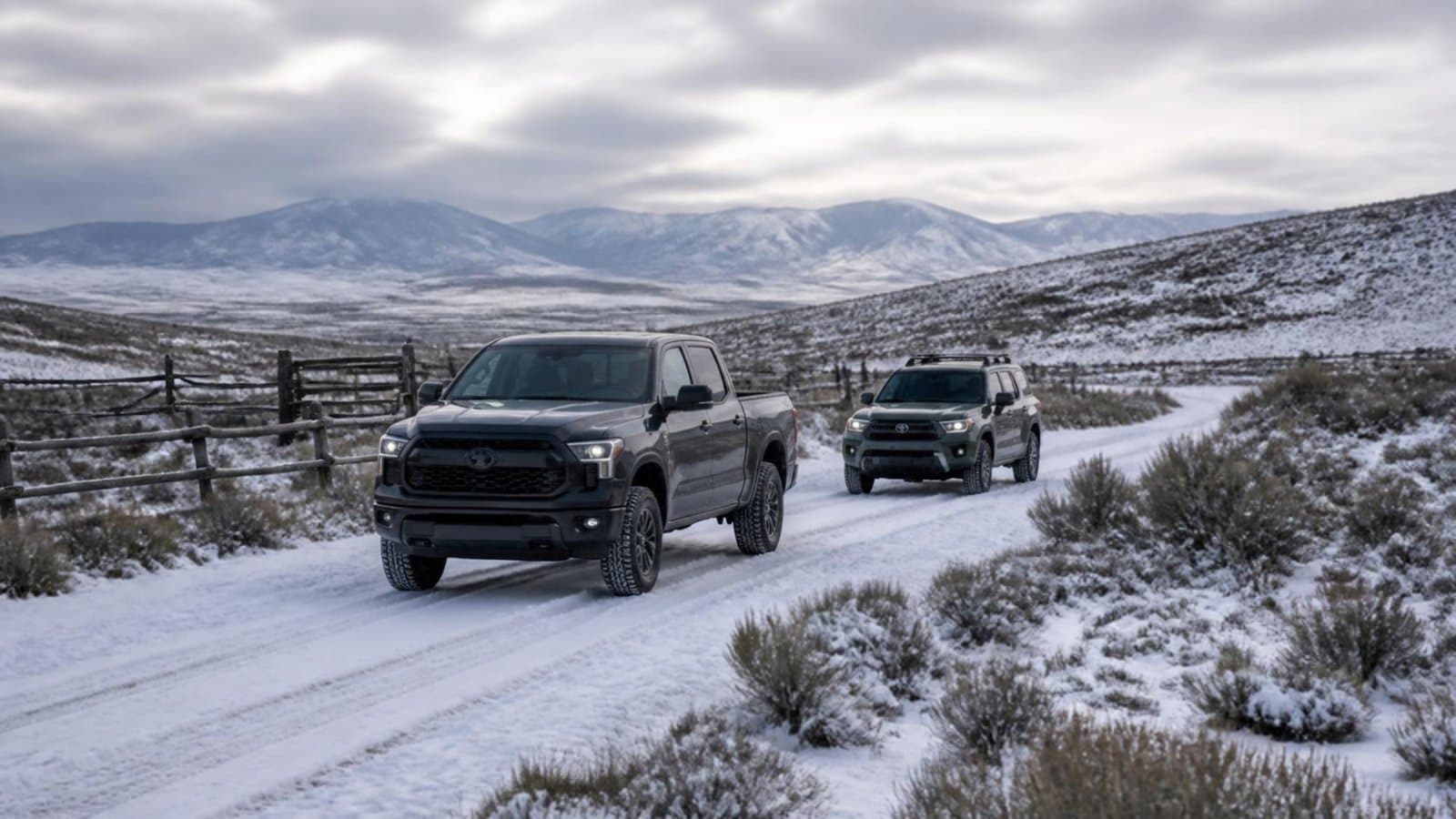
AWD is better for everyday plowed and icy roads because it sends power to all four wheels on its own. Part-time 4WD is better for deep, unplowed snow and ranch roads. Neither system helps you stop or steer on ice. Your tires do that, and Colorado still requires rated tires with 3/16 inch of tread.
The AWD vs 4WD question comes up every fall, usually right before the first real storm rolls over the Yampa Valley. Both systems send power to all four wheels, but they do it in different ways, and that difference decides which one is better on US-40 at 6am versus a drifted county road out to a ranch gate.
This guide from Chapman's Automotive in Craig explains how each system works, which one suits the driving you actually do, when to shift a part-time 4WD truck into 4H or 4L, and why neither one will stop you on ice. It also covers what Colorado's traction law requires of AWD and 4WD vehicles, and the maintenance that keeps either system from failing in January.
Key takeaways:
AWD works automatically all the time; part-time 4WD stays in two-wheel drive until you shift it into 4H or 4L.
AWD and 4WD help you get moving, but CDOT says that when it comes to stopping or turning, nothing is more important than your tires.
Under Colorado's traction law, an AWD or 4WD vehicle complies only with M+S, mountain-snowflake or all-weather rated tires that have at least 3/16 inch of tread.
Part-time 4WD in 4H or 4L does not belong on dry pavement, where it binds the driveline and can damage it.
AWD systems need four matched tires; a Kia service bulletin says all four should be within 10 mm of each other in circumference.
Table of Contents
How do you keep an AWD or 4WD system healthy through winter?
Get your drivetrain and tires checked before the first storm
What is the difference between AWD and 4WD?
The short answer: AWD decides for you, and part-time 4WD waits for you to decide. Both drive all four wheels, but AWD varies how much power goes to each axle on its own, while a part-time 4WD system locks the front and rear axles together when you select it.
How AWD works
Subaru describes AWD as a system that distributes varying amounts of torque to each axle. There are two kinds:
Full-time AWD sends some power to both axles at all times. Most Subarus use this type.
Part-time AWD drives mostly the front or rear wheels in normal conditions and adds power to the other axle when sensors detect slip. CDOT's winter driving FAQ notes that during normal conditions, most AWD vehicles use just the front wheels.
Either way, you do not push a button. That is the main advantage of AWD on a winter commute: it reacts to a patch of ice hidden under fresh snow before you know it is there.
How 4WD works
Most pickups and body-on-frame SUVs use part-time 4WD. CDOT puts it simply: with part-time four-wheel drive, most vehicles are rear-wheel drive until the driver manually shifts into four-wheel drive. A transfer case then locks the front and rear driveshafts together so both axles turn at the same speed.
Many newer trucks also offer an automatic 4WD mode. Here is how Ford describes the common settings:
| Setting | What it does | When to use it |
|---|---|---|
| 2H | Rear-wheel drive only | Dry or wet pavement |
| 4A (4 Auto) | Electronically controlled 4WD that sends power front and rear as needed | Varied road conditions, mixed snow and pavement |
| 4H | Locked 4WD to front and rear wheels | Deep snow, sand or mud; not for dry pavement |
| 4L | Locked 4WD with extra gearing for torque | Off-road only: deep sand, steep grades, pulling heavy loads |
The locked axles are what make 4WD strong in deep snow, and they are also why it has rules about where you can use it, covered below.
Is AWD or 4WD better in snow?
AWD is the better choice for most winter driving on plowed and sanded roads, and part-time 4WD is the better choice when the snow is deep, the road is unplowed, or you are pulling a load through it. The right answer depends on where you drive, not which system sounds tougher.
Choose AWD if most of your winter miles are on paved roads such as US-40 between Craig, Hayden and Steamboat Springs, in town, or on plowed highways where conditions change from bare to icy and back within a mile.
Choose 4WD if you regularly drive unplowed county roads, ranch roads, hunting access or steep two-tracks, need ground clearance for drifted snow, or tow through winter conditions.
Either one needs good winter-rated tires, because a drive system can only use the grip the tires provide.
Can AWD get stuck in snow?
Yes. AWD is not a guarantee of getting through. Most AWD crossovers and cars have less ground clearance than a truck, so in deep snow the body can ride up on the snowpack until the tires lose contact. Tires with worn tread pack with snow and spin, and no drive system can put power through a tire that has no grip.
If you get stuck, ease off the throttle rather than spinning harder. Spinning polishes the snow under the tires into ice and digs you deeper.
2WD vs 4WD in snow
Braking does not depend on which wheels are driven, so a two-wheel-drive vehicle on good winter tires is not at a stopping disadvantage because of its drive system. Where 2WD falls short is getting moving uphill and pushing through deep snow. In Colorado it also falls short legally, because the current traction law gives 2WD vehicles only one way to comply: chains or an approved alternative traction device (see below).
Why neither AWD nor 4WD helps you stop on ice
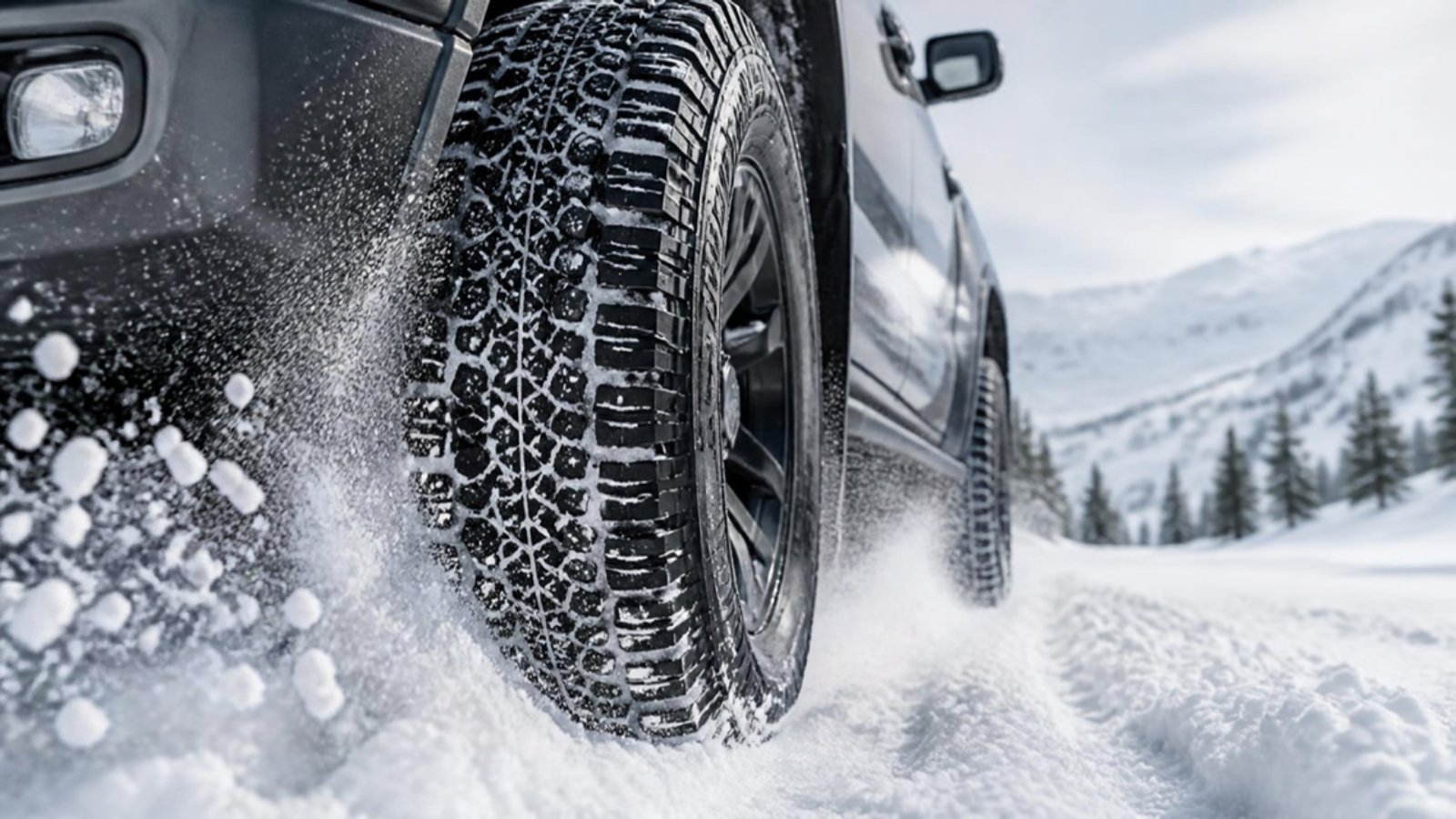
AWD and 4WD only help you accelerate. Every vehicle brakes on all four wheels, whether one axle or two is driven, so the drive system adds nothing once you hit the brake pedal or turn the wheel. CDOT's FAQ says it plainly: AWD and 4WD may help you accelerate on slick or snowy terrain, but when it comes to stopping or turning, nothing is more important than your tires. The same page says winter, all-weather and M+S tires stop much more quickly than regular all-season tires in winter conditions.
This matters because the extra grip you feel pulling away from a light can make the road seem better than it is. An AWD or 4WD vehicle can reach a speed on snow that its tires cannot stop it from.
The stakes are real. According to the Federal Highway Administration, using five-year averages from 2019 to 2023, about 186,076 crashes a year happen on snowy or slushy pavement and about 156,164 a year on icy pavement in the United States.
Tread is what gives a tire grip in snow. The U.S. Tire Manufacturers Association says tread equals traction, especially in bad weather, and that tires should be checked at least once a month, when cold. If your tires are low, our snow tire installation page explains the winter options.
What does Colorado's traction law require for AWD and 4WD?
AWD or 4WD alone does not make your vehicle legal when the traction law is in effect. CDOT's traction law page, updated for fall 2025, says that during a traction law every motorist must have one of these:
An AWD or 4WD vehicle with mud and snow tires (M+S or M/S, or the mountain-snowflake icon) and 3/16 inch of tread depth
An AWD or 4WD vehicle with winter tires and 3/16 inch of tread depth
An AWD or 4WD vehicle with tires carrying an all-weather rating from the manufacturer and 3/16 inch of tread depth
Chains or an approved alternative traction device
Two details are worth knowing. First, that list gives a two-wheel-drive vehicle no option other than chains or an approved traction device. Second, CDOT's winter driving FAQ says AWD and 4WD are compliant as long as all tires have at least 3/16 inch of tread, without mentioning the tire rating. The traction law page is the more specific of the two and carries the fall 2025 update, so the safe reading is to meet both: a rated tire and 3/16 inch of tread on all four.
The fine for not complying is $100 plus a $33 surcharge, and $500 plus a $157 surcharge if your vehicle causes a lane closure, per CDOT. The FAQ adds that CDOT can put the traction and chain laws into effect on all state highways, not only I-70. When the stricter passenger vehicle chain law is called, every vehicle needs chains or an approved alternative traction device, AWD and 4WD included.
When should you use 4WD in snow?
Shift into 4H when the road is covered in snow, slush or ice and stays that way, and shift back to 2H as soon as you reach bare, dry pavement. A part-time system has no way to let the front and rear axles turn at different speeds, so on dry pavement the tires scrub and the driveline binds in every turn.
Manufacturers are direct about this. Ford says 4H is best used in deep snow, sand or mud and is not intended for use on dry pavement. The Ram 2500/3500 owner's manual warns that driving in 4WD HIGH or 4WD LOW on dry hard-surfaced roads may cause increased tire wear and damage to driveline components.
Use 4A (4 Auto), if your truck has it, on roads that switch between snow and pavement.
Use 4H on steady snow, slush or ice, and on unplowed roads.
Use 4L only for slow, hard work: getting unstuck, climbing a steep snowy two-track, or pulling a trailer out of a snowy lot. The Ram manual says not to exceed 25 mph in 4WD LOW.
Do not shift while the rear wheels are spinning; Ford advises against shifting 4WD while the rear wheels are slipping or while accelerating.
Check your own owner's manual for the shift procedure and speed limits for your truck, because they vary by system.
How do you keep an AWD or 4WD system healthy through winter?
Keep the tires matched, keep the fluids fresh, and listen for the warning signs before a storm makes the system work hardest.
Keep all four tires matched
AWD systems are sensitive to tires of different sizes, because a smaller tire has to turn faster than the others to cover the same road and the drivetrain has to absorb the difference. A 2023 Kia technical bulletin filed with NHTSA warns that tires of differing circumference can cause a chatter in the drivetrain and failure of AWD components. Kia says all four tires should be within 10 mm of each other in circumference, and if they are not, all four need replacing. It also says to rotate tires at the interval in the owner's manual.
That is why replacing one damaged tire on an AWD vehicle is not always simple. Check your owner's manual before buying a single tire or a pair, and have your tires and alignment checked so they wear evenly.
Keep the drivetrain fluids fresh
Both systems rely on fluids that sit out of sight:
Front and rear differential fluid, on AWD and 4WD alike
Transfer case fluid on 4WD trucks
The coupling or transfer unit that feeds the rear axle on many AWD crossovers
Follow the severe-service interval in your owner's manual if you tow, plow, or drive through water and mud, and change fluid that looks milky right away, because that means water has gotten in. Our drivetrain and differential service covers differentials, transfer cases, AWD couplings and CV axles.
Watch for these warning signs
A whine or howl that rises and falls with road speed, which points to a differential
4WD that will not engage, or a 4WD indicator that blinks and does not lock in
A shudder, chatter or binding feel in tight, slow turns on an AWD vehicle
Clicking in turns, which usually means a worn CV joint
Fluid spots under the front or rear axle
If you drive a Subaru, the CVT, rear differential and front CV axles all feed the AWD system, and our Subaru repair page covers what that system needs.
Get your drivetrain and tires checked before the first storm
The best time to find a worn tire, a mismatched set or tired differential fluid is in the shop, not on the shoulder of US-40. A free digital inspection with photos is the easy way to see where your tires and drivetrain stand, and you get a written estimate before any work begins. Free loaner cars, shuttle and pickup keep you moving while it is done. You can book an appointment online or call Chapman's Automotive at 970-550-2883.
Sources
Federal Highway Administration: How do weather events impact roads?
Kia technical bulletin PS750: AWD system concern due to tire circumference (via NHTSA)
FAQ
Is AWD or 4WD better in snow?
AWD is better for everyday plowed and icy roads because it engages on its own and reacts quickly. Part-time 4WD is better for deep, unplowed snow, steep ranch roads and towing. Both depend on good tires to stop and steer.
Do I use 4WD in snow on the highway?
Use 4H or 4A when the highway is snow-covered or icy, and shift back to 2H once the road is bare and dry. Locked 4WD on dry pavement binds the driveline and can damage it.
Can AWD get stuck in snow?
Yes. AWD cannot help a tire that has no grip, and most AWD cars and crossovers sit lower than trucks, so they can high-center in deep snow. Rated winter tires with good tread make the biggest difference.
Does AWD or 4WD help you stop on ice?
No. Every vehicle brakes on all four wheels regardless of its drive system, so stopping and turning come down to your tires and your speed. CDOT says nothing is more important than your tires for stopping or turning.
Is an AWD car legal under Colorado's traction law with any tires?
No. CDOT's traction law page requires AWD and 4WD vehicles to have M+S, mountain-snowflake or all-weather rated tires with at least 3/16 inch of tread, or chains or an approved traction device. Bald or summer tires do not comply.
Questions about your vehicle?
Chapman's Automotive is in Craig, CO — serving the Yampa Valley. Call 970-550-2883 or book online and we'll take a look.