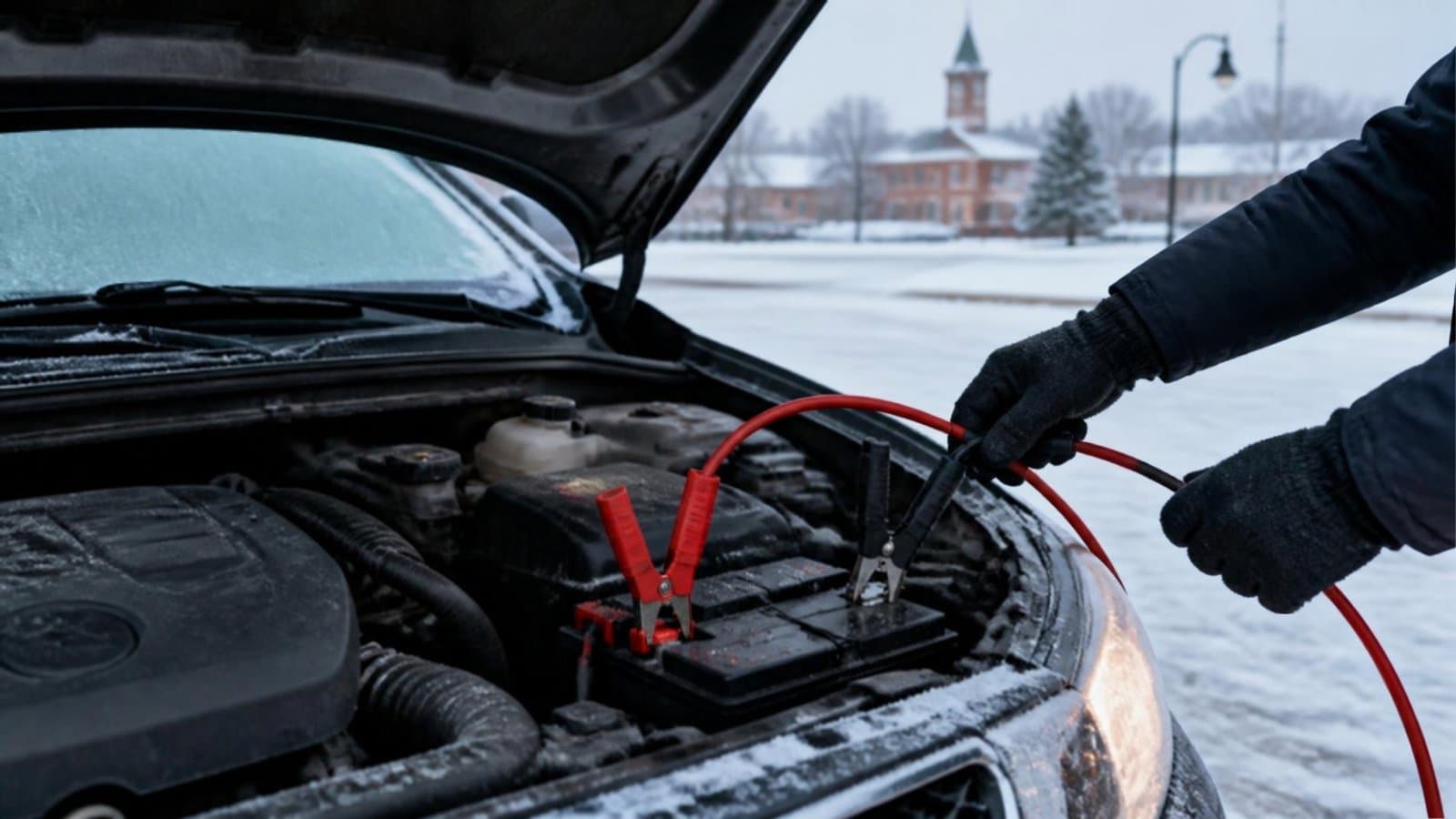
Listen to what happens when you turn the key. Rapid clicking or a slow, labored crank points to a weak battery or loose cables. A single click with bright dash lights points to the starter. Normal cranking with no start rules out both and points to fuel, spark or the anti-theft system. A test confirms which before you buy parts.
Your car will not start, you are already late, and the question is whether you need a jump, a tow or a new part. The good news is that the engine usually tells you which. The sound it makes when you turn the key, or the silence, narrows a no-start down to a short list before anyone opens the hood.
This guide walks through the symptom tree: no crank, a single click, rapid clicking, a slow crank, a car that cranks but will not start, and a car that will not take a jump. It also covers the cold-morning angle that matters in Craig and the rest of the Yampa Valley, plus a short section on diesels. The team at Chapman's Automotive in Craig tests the battery, starter and alternator together for this reason: guessing wrong is how people buy two parts to fix one problem.
Key takeaways:
The sound the engine makes when you turn the key is the fastest way to narrow down a no-start.
AAA reports a battery loses about 35 percent of its strength at 32°F and about 60 percent at 0°F, while the engine needs up to twice the current to crank.
If a jump start does not work, the problem is usually the cable connection, a deeply drained battery, the starter, or something outside the electrical system.
An engine that cranks at normal speed but will not fire has a working battery and starter.
Diesels add glow plugs, two batteries and fuel gelling to the list on cold mornings.
Table of Contents
Nothing happens, or just one click: is it the battery or the starter?
Slow crank or rapid clicking on a cold morning: is it the battery?
What does the sound tell you when your car won't start?
Start with what you hear and see in the first two seconds. That one observation sorts most no-starts into the right branch.
| What happens when you turn the key | Dash lights | Most likely cause | Where to look next |
|---|---|---|---|
| Nothing at all, no click | Dead or off | Fully drained battery or a loose or corroded cable | Battery and terminals |
| Rapid clicking or chattering | Dim or flickering | Weak battery, or a poor cable connection | Battery, cables, charging system |
| One loud click, no crank | Bright | Starter motor, starter solenoid or its wiring | Starter circuit |
| Slow, labored crank that may not catch | Dim while cranking | Weak or cold-soaked battery | Battery and alternator |
| Whine or grinding, engine not turning | Bright | Starter drive gear or flywheel teeth | Starter and flywheel |
| Normal-speed crank, never fires | Normal | Fuel, spark, anti-theft, or compression | Fuel, ignition, security light |
| Starts, then dies within seconds | Normal | Anti-theft system or fuel delivery | Security light, fuel pump |
Before you go down any branch, rule out the simple things that stop a modern car from even trying:
Make sure an automatic is fully in Park. Try moving the shifter to Neutral and starting again, since a worn park/neutral switch can block the starter.
On a push-button start, press the brake pedal firmly, and on a manual, press the clutch all the way down. Both pedals have switches that must close before the starter will engage.
If the key will not turn, turn the steering wheel slightly left or right while you turn the key to release the steering lock.
If you have a key fob, a weak fob battery can stop the car from recognizing it. Many cars let you hold the fob against the start button or a marked spot on the column as a backup.
Look for a flashing key or padlock symbol on the dash. That is the anti-theft immobilizer refusing the key, and no amount of cranking or jumping fixes it.
If none of those apply, the sound in the table is your guide to the sections below.
Nothing happens, or just one click: is it the battery or the starter?
The dash lights decide this one. If the lights are dead or go dark when you turn the key, the starter is not getting enough power, and the battery or its cables are the problem. If the lights stay bright and you hear one solid click, the battery is doing its job and the power is stopping at the starter.
That single click is the starter solenoid trying to engage. When the solenoid clicks but the motor does not spin, the cause is a worn starter motor, a failing solenoid, or a corroded or loose cable at the starter or the ground connection. A battery that is very low can also produce one click, which is why Interstate Batteries describes one big click as a dead-battery sign in its no-start guide. The dash lights tell the two apart: dim lights with the click point to the battery, bright lights point to the starter side.
Before you blame either part, check the battery terminals. White or green crust on the posts, or a cable you can twist by hand, can stop a healthy battery from delivering current. Cleaning and tightening the connections fixes more no-starts than you would expect.
What does a failing starter motor sound like?
A failing starter motor usually gives warnings before it quits. These are the sounds to listen for:
A single click with no cranking, sometimes only on the first try of the day, then it starts on the second or third attempt.
A crank that sounds normal some days and slow or absent on others, even with a good battery. Intermittent starting is a classic starter symptom.
A high-pitched whine or whirring with the engine not turning. The motor is spinning but the drive gear is not engaging the flywheel.
A harsh grinding noise during cranking, which points to worn teeth on the starter gear or the flywheel ring gear.
Smoke or a burning smell after repeated cranking, which means the starter or its wiring is overheating.
A starter that does this is on borrowed time, and the problem tends to show up on the coldest morning or the farthest trailhead. Do not keep cranking it in long bursts. Interstate Batteries notes in the same guide that starters are not designed to run for more than 30 seconds at a time, so crank in short tries and let it rest between them.
A grinding starter is also worth fixing quickly because a starter that keeps chewing on the flywheel can damage the ring gear, which turns a starter replacement into a much bigger job. If you suspect the starter, our battery, starter and alternator repair visit measures how much current the starter draws while cranking, which shows whether the motor is failing or simply starved for power.
Slow crank or rapid clicking on a cold morning: is it the battery?
Usually, yes. A slow, labored crank or a rapid chattering click both mean the starter is not getting enough current, and the battery is the most common reason. Cold makes it worse in two ways at once: the battery delivers less power, and the thickened engine oil makes the engine harder to turn.
AAA puts numbers on it. According to the AAA Automotive Research Center, as reported by AAA Hudson Valley, a car battery loses about 35 percent of its strength at 32°F and about 60 percent at 0°F, while the engine may need up to twice the normal current to start. The same AAA article puts the average battery life at three to five years, and closer to three in vehicles with more electronics.
Those temperatures are ordinary winter mornings here. The Western Regional Climate Center daily averages for the Craig 4 SW station put the typical early-January low at about 5 to 6°F (averages from available years, 1961 to 1990), so a battery that started fine in October can be working with less than half its strength by January.
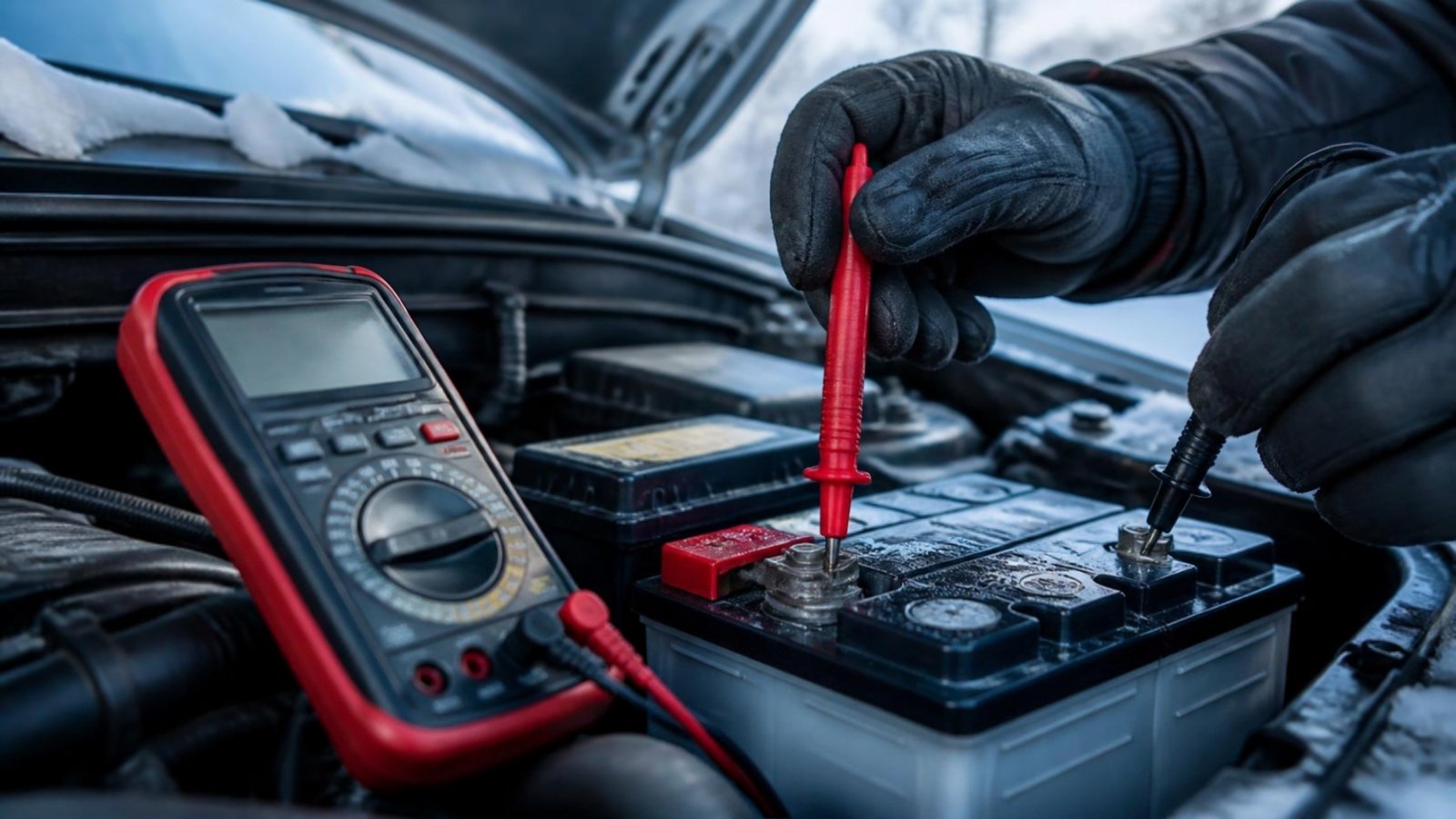
A battery that cranks slowly is not always worn out. It may simply be undercharged, which points to the alternator or to something draining the battery with the car off. Interstate Batteries' multimeter test guide gives two quick readings: a resting voltage of around 12.5 volts with the car off, and higher than 13 volts with the engine running. Below 13 volts with the engine running, it says, you could have a bad alternator or a bad battery. A voltmeter reading is a useful first check, but a load test is what shows whether a battery can still deliver current under cranking.
If the slow crank only shows up on cold mornings and the battery is a few winters old, the battery is the likely answer. If a newer battery keeps going flat, the alternator or a parasitic drain is the more likely problem.
Why won't the car jump start?
When a jump start fails, the jump itself is often the problem. Work through these in order:
Poor clamp contact. Clamps sitting on corroded terminals or on a painted bracket will not pass enough current. Wiggle them onto clean metal and try again.
Not enough charging time. A deeply drained battery can soak up the donor current for several minutes before there is enough left to crank. Let the donor vehicle run with the cables connected for a few minutes before you try.
Thin or long cables. Light-gauge jumper cables lose too much current to crank a truck or a large engine, especially in the cold.
A battery that will not accept a charge. A battery with a shorted cell, or one that has frozen, may not recover with a jump. A battery that has frozen solid or shows a cracked or bulging case should be replaced, not jumped.
A failed starter. If the jump brings the dash lights up bright but you still get one click, the power is there and the starter is not using it.
A problem outside the electrical system. If the engine cranks strongly on the jump but still will not fire, the battery was never the issue. Go to the cranks-but-will-not-start section below.
If the car starts on a jump and then dies within a few minutes, or starts but will not restart later the same day, suspect the alternator. The alternator is supposed to recharge the battery once the engine runs, and a car that keeps needing jumps is usually telling you it is not.
The engine cranks but will not start: what does that mean?
A normal-speed crank is good news for your battery and starter. An engine needs fuel, spark and compression to run, so if it spins at normal speed but never fires, one of those three is missing, or the anti-theft system has shut one off on purpose.
Fuel
Check the obvious first: a gauge that reads near empty can still leave the pickup dry, especially parked on a slope. With the key in the run position, many vehicles run the fuel pump for a couple of seconds, and you can hear a faint hum from the tank area. Silence can point to a failed pump, a blown fuse or a bad relay. A clogged fuel filter or a failing pump can also let the engine catch and then stall.
Spark
Worn spark plugs, a failed ignition coil or a bad crankshaft position sensor can all stop the engine from firing. The crankshaft sensor is a common one because, when it fails, the engine computer does not know the engine is turning, so it never fires the plugs or injectors. These faults usually leave a code, which is why an auto diagnostics scan is the right next step once you know the battery and starter are fine.
Security
If the security light is flashing, or the engine starts for a second and dies, the immobilizer may be cutting fuel because it does not recognize the key. Try your spare key before anything else. If the spare works, the problem is the original key or its chip, not the engine.
Compression
An engine that cranks noticeably faster and lighter than normal, with no attempt to fire, may have lost compression. On an engine with a timing belt, a snapped belt causes exactly that. Do not keep cranking it. AAA notes that a broken timing belt not only stops the engine from running but can let internal parts fall out of sync and crash into one another, bending valves. See our timing belt replacement page for why the belt is worth replacing before it gets to that point.
Why won't a diesel start in the cold?
Diesels add three cold-weather causes that gasoline engines do not have: glow plugs, gelled fuel and a two-battery system. A diesel ignites its fuel with heat from compression alone, so a cold engine needs help to get the combustion chamber hot enough to fire.
Glow plugs. These heat the combustion chambers before cranking. Wait for the wait-to-start light to go out before you turn the key, and if it comes on again, cycle it once more. A diesel that cranks a long time, starts rough and blows white smoke on cold mornings often has one or more failed glow plugs or a glow plug controller fault. Many diesels also run a grid heater in the intake that does the same job.
Gelled fuel. Diesel contains wax that crystallizes in the cold. DieselNet defines the cloud point as the temperature at which a haze of wax crystals starts to appear in the fuel, and notes that those crystals can collect in filters and block the fuel system. A diesel that starts and then dies, or will not start after a hard cold snap, may have a waxed fuel filter. DieselNet also notes that cold-flow additives usually have little effect on the cloud point itself and work by limiting filter blockage, so add treatment before the cold, not after the fuel has already gelled.
Two batteries. Many Power Stroke, Duramax and Cummins pickups run two batteries that share the cranking load. One weak battery drags the healthy one down, so both need to be tested separately.
A block heater plugged in overnight makes every one of these easier on the coldest mornings. If your truck is already struggling, our diesel repair team checks glow plugs, the fuel filter and both batteries in one visit.
Get a free charging-system test before you buy parts
If your car is slow to crank, clicking, or needed a jump this week, the cheapest next step is a test, not a part. Our free battery and charging-system test checks the battery, starter draw and alternator output together, so you replace only the part that actually failed. Getting ready for winter? A fall test pairs well with our winterization service. Every repair comes with a written estimate before any work starts. Book your test on the battery, starter and alternator page or call Chapman's Automotive in Craig at 970-550-2883.
Sources
AAA Hudson Valley: Cold weather and your car battery (AAA Automotive Research Center figures)
Western Regional Climate Center: Craig 4 SW, Colorado daily temperature summary
Interstate Batteries: How to test a car battery with a multimeter
Interstate Batteries: Why my car will not start if the battery is still good
FAQ
Can a bad alternator make a car not start?
Yes, but indirectly. A failing alternator stops recharging the battery, so the car runs on battery power until the battery is too low to crank. If a new or freshly charged battery keeps going flat, test the alternator before you buy another battery.
Why does my car click but not start when the lights work?
Bright lights with a single click usually mean the battery is fine and the starter, its solenoid or the cable connection is not passing current to the motor. Rapid clicking with dimming lights points the other way, toward a weak battery.
How do I know if it is the battery or the starter?
Try a jump start. If the car starts on the jump, the battery or charging system is the likely cause. If the jump brings the lights up bright and you still get one click or nothing, the starter circuit is the likely cause.
How many times should I try to start a car that will not start?
Crank in short tries with a rest between them rather than one long attempt. Interstate Batteries notes that starters are not designed to run for more than 30 seconds at a time, and repeated long cranking can overheat the starter and drain what is left of the battery.
Should I replace my battery before winter?
If it is more than three years old or already cranks slowly, test it in the fall. AAA puts average battery life at three to five years, and the first cold snap is when a tired battery usually gives out.
Questions about your vehicle?
Chapman's Automotive is in Craig, CO — serving the Yampa Valley. Call 970-550-2883 or book online and we'll take a look.