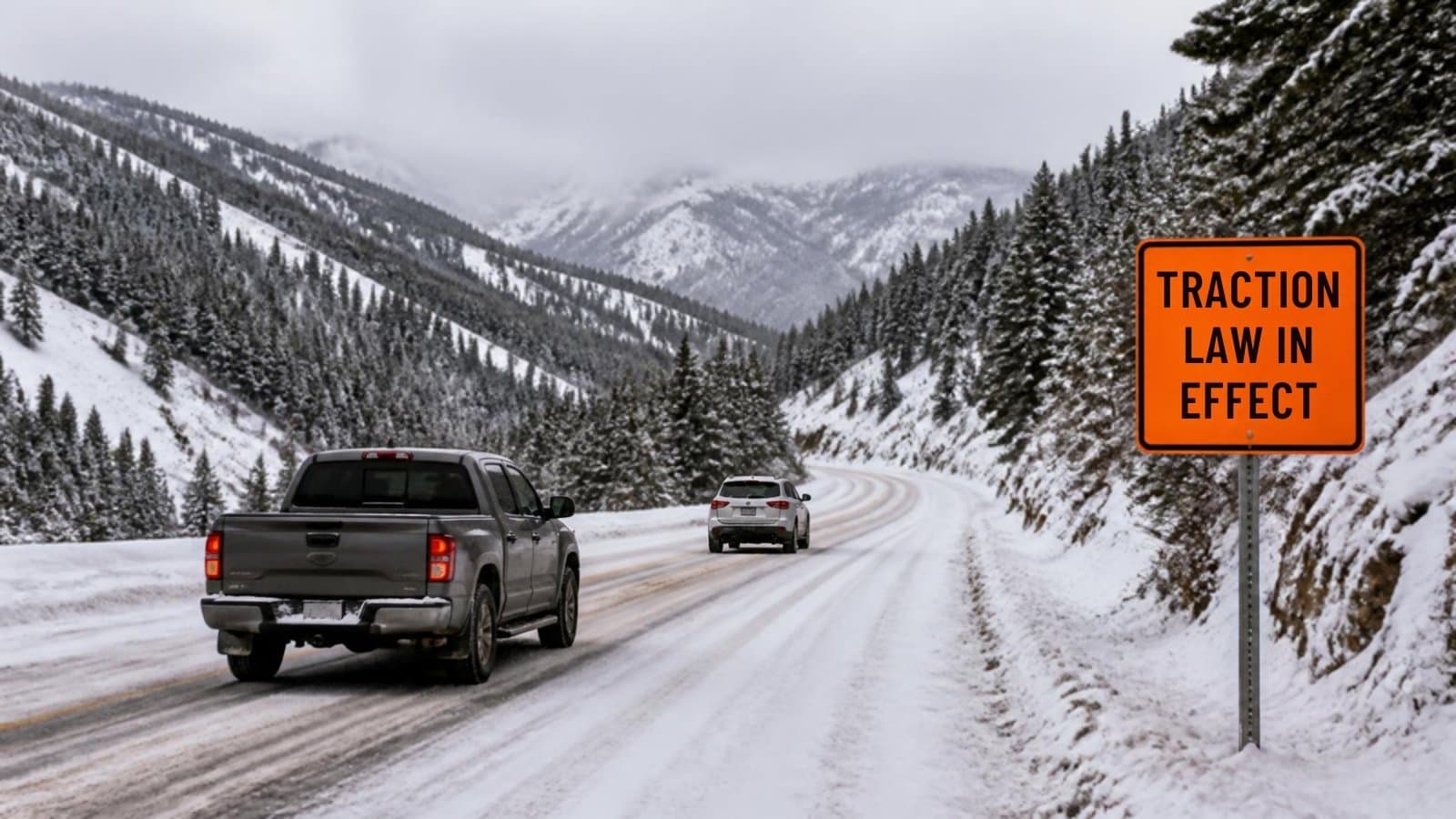
Colorado's Traction Law is the first step: an AWD or 4WD vehicle passes with M+S, mountain-snowflake or all-weather rated tires that have at least 3/16 inch of tread, and every other vehicle needs chains or an approved traction device. The Passenger Vehicle Chain Law is the last step before a closure: every vehicle needs chains or an approved device.
Colorado chain law and traction law sound like the same rule, but they are two different steps, and the 2025 update changed who passes the first one. If you drive a front-wheel-drive car, or an AWD vehicle on worn tires, you may already be out of compliance without knowing it.
This guide covers what each law requires, the new tire rules for 2WD, AWD and 4WD, how to check your own tires, where and when the laws apply, the fines, and what commercial drivers need to know. It is written for drivers in Craig and the Yampa Valley, where a trip to the Front Range or over a mountain pass is part of normal winter life. Chapman's Automotive in Craig fits and checks winter tires, so the last section covers how to get yours checked before the first storm.
Key takeaways:
Since the 2025 update, a two-wheel-drive car cannot pass the Traction Law on tires alone, according to CDOT; it needs chains or an approved device on two or more drive tires.
AWD and 4WD only count when the tires carry an M+S, mountain-snowflake or all-weather mark and have at least 3/16 inch of tread.
On I-70 between Dotsero (milepost 133) and Morrison (milepost 259), the Traction Law is in effect every year from September 1 to May 31.
CDOT can switch either law on for any state highway when snow or ice calls for it.
3/16 inch is three times the 2/32-inch point at which USTMA says a tire is worn out, so passing the penny test does not prove you are legal.
Table of Contents
What is the difference between Colorado's chain law and traction law?
Does AWD or 4WD meet the chain law or traction law on its own?
What are the fines for breaking Colorado's chain or traction law?
What does the chain law mean for trucks and commercial vehicles?
What is the difference between Colorado's chain law and traction law?
The Traction Law is the everyday winter restriction, and the Chain Law is the emergency one. According to the Colorado Department of Transportation (CDOT), the Passenger Vehicle Chain Law is "the final safety measure before the highway is closed."
| Traction Law | Passenger Vehicle Chain Law | |
|---|---|---|
| When CDOT uses it | Winter storms or when conditions require | Severe winter storms, before a closure |
| AWD or 4WD with rated tires and 3/16 inch of tread | Complies | Not enough on its own |
| Two-wheel drive on any tires | Needs chains or an approved device | Needs chains or an approved device |
| Chains or an approved alternative traction device | Complies | Required on every vehicle |
| Where | Any state highway; always on the I-70 mountain corridor from September 1 to May 31 | Any state highway |
Both laws come from the same statute, C.R.S. 42-4-106(5), which lets CDOT restrict travel when icy or snow-packed conditions exist. A restriction takes effect when signs, including temporary or electronic signs, are posted on the highway.
What do Code 15, Code 16 and Code 18 mean?
They are older shorthand you will still hear. A 2015 CBS Colorado report called the Traction Law "Code 15" and the passenger chain law "Code 16," and FreightWaves describes the commercial chain law in two levels, Level 1 (Code 17) and Level 2 (Code 18). CDOT's current traction law page and its November 2025 news release use the names, not the numbers, so watch for the words "Traction Law" and "Chain Law" on the signs.
What tires does the Colorado traction law require in 2025?
Under the current rules, you comply with the Traction Law in one of two ways, according to CDOT's November 2025 release:
An AWD or 4WD vehicle with tires that have at least 3/16 inch of tread and are rated as all-weather, mud and snow (M+S or M/S), or winter (the three-peak mountain-snowflake symbol).
Chains or an approved alternative traction device on two or more drive tires.
The change came from Senate Bill 25-069, signed May 15, 2025 and effective August 6, 2025, which rewrote the equipment list in C.R.S. 42-4-106. Before the change, the statute let any vehicle pass on M+S, mountain-snowflake or all-weather tires with 3/16 inch of tread, and let AWD and 4WD pass on any tires with 3/16 inch of tread. Some pages online still describe those older rules, so check the date on anything you read.
What the sidewall marks mean
The statute counts tires that are "imprinted by a manufacturer" with a mountain-snowflake, M&S, M+S or M/S symbol, or that are all-weather rated by the manufacturer. That means the mark molded into the sidewall is what counts, not what the tire is called on a receipt or a website.
M+S, M/S or M&S means the manufacturer rates the tire for mud and snow.
The mountain-snowflake symbol (a mountain outline with a snowflake inside) is the mark CDOT uses for winter tires.
An all-weather rating from the manufacturer also qualifies, as long as the tread is deep enough.
If you cannot find any of these marks, plan on carrying chains or an approved device whenever the law is in effect, or switch to a set of dedicated winter tires that carry the mountain-snowflake mark.
What counts as chains or an approved traction device?
Colorado law defines tire chains as metal chains with two circular loops, one on each side of the tire, joined by no fewer than nine evenly spaced chains across the tread. CDOT keeps a list of approved alternatives on its traction law page, which includes AutoSock, EasySox, ISSE Tire Sock and Alpha Trax. Buy the size that matches the tire size printed on your sidewall, and practice fitting them in your driveway before you need them on a dark shoulder.
Does AWD or 4WD meet the chain law or traction law on its own?
No. AWD or 4WD only helps you comply with the Traction Law when it is paired with rated tires that have 3/16 inch of tread, and it does nothing for you under the Chain Law, where every vehicle needs chains or an approved device.
CDOT explains the reason in its winter driving FAQ: AWD and 4WD may help you accelerate on slick or snowy roads, but when it comes to stopping or turning, "nothing is more important than your tires." The same FAQ notes that winter, all-weather and M+S tires stop much more quickly than regular all-season tires in winter conditions.
Two practical points for AWD and 4WD owners:
With part-time 4WD, most vehicles drive the rear wheels until you engage 4WD yourself, CDOT notes. If your truck is in 2WD, it is driving as a two-wheel-drive vehicle.
AWD systems shift power between wheels on their own. If yours is slipping, binding or throwing warning lights, have it looked at before winter; our drivetrain and differential service covers transfer cases, differentials and AWD units.
How do you check for 3/16 inch of tread?
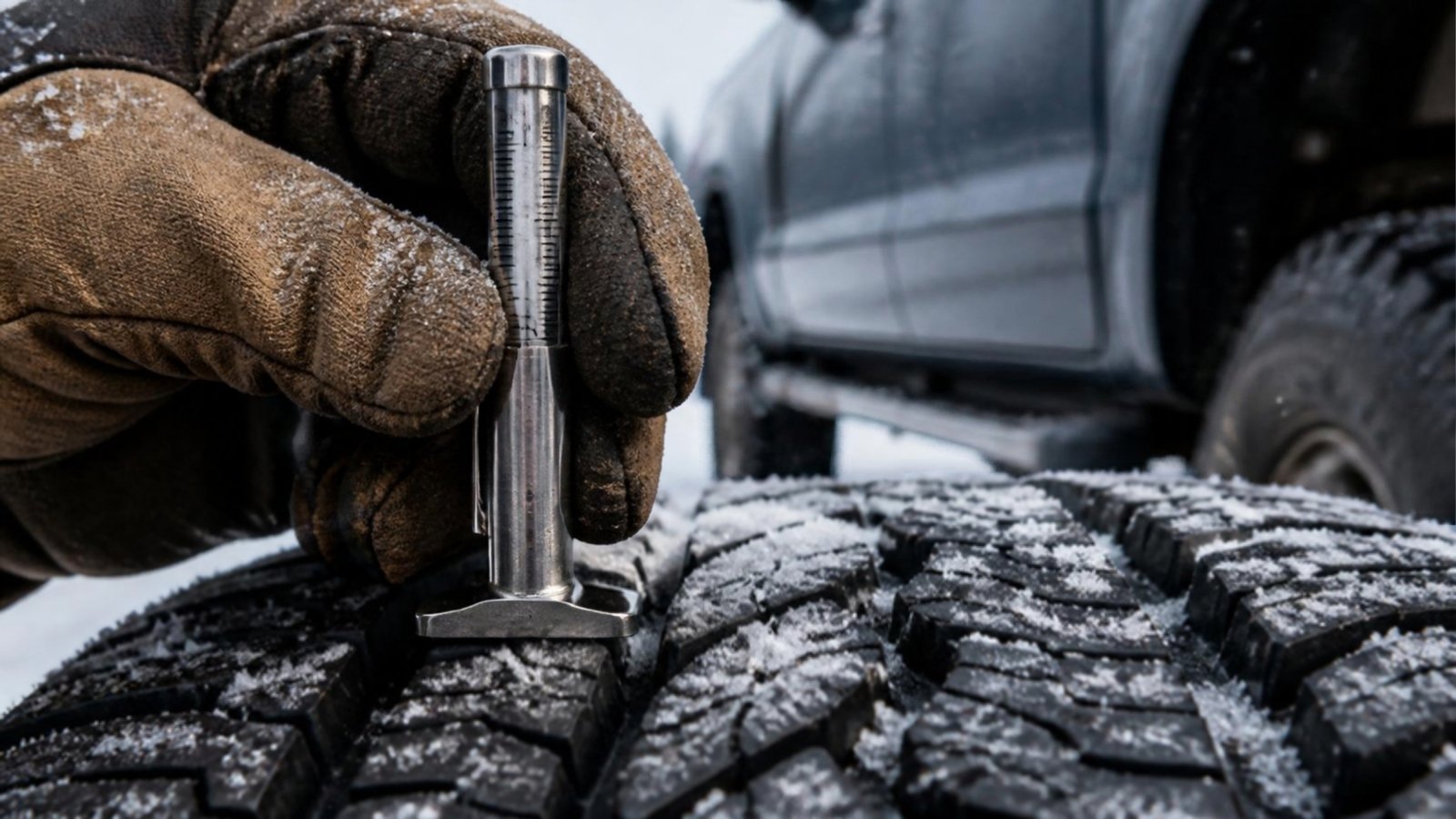
Use a tread depth gauge in the main grooves across the full width of each tire, because the law sets the minimum on the tires, and a single worn edge can put a tire under. 3/16 inch is the same as 6/32 inch.
That is why the penny test is not enough here. The U.S. Tire Manufacturers Association says a tire is due for replacement once tread wears down to 2/32 inch, and the penny test is built around that point. A tire can pass the penny test and still be a full 4/32 inch short of the traction law minimum.
A quick check routine before the snow season:
Measure each tire at the inside, center and outside grooves.
Look for the tread wear bars; USTMA says a tire needs replacing when the tops of those bars are flush with the tread.
Find the M+S, mountain-snowflake or all-weather mark on each sidewall.
Set pressures cold. USTMA notes that pressure drops one to two pounds for every 10 degrees of temperature drop.
If the inside and outside edges wear at different rates, that usually points to alignment, and it will cost you tread depth faster. A wheel alignment and tire check catches it before it eats a set.
Where and when do the laws apply?
There is no fixed Colorado chain law map, because CDOT can activate the Traction Law or the Chain Law on any state highway when conditions call for it. The one standing restriction is on I-70: the statute puts the traction requirements in effect between milepost 133 at Dotsero and milepost 259 at Morrison from September 1 through May 31 every year.
Everywhere else, the law is in effect when the signs say it is. CDOT says you will be alerted by highway signage, COtrip.org and its traffic and road condition alerts. For a Craig driver, that covers the state highways you use every winter, including US 40 east toward Steamboat Springs and Rabbit Ears Pass, so check COtrip before you leave rather than finding out at the top of a grade.
Enforcement is mostly about what happens when things go wrong. CDOT's FAQ says the Colorado State Patrol enforces the Traction and Chain Laws as secondary offenses, which means a trooper can only cite you if you crash or cause traffic delays and are not compliant. That is not a reason to skip it: a spin-out on a pass is exactly the situation that leads to a ticket.
What are the fines for breaking Colorado's chain or traction law?
CDOT's own pages do not agree on the base fine, so here are all three figures, attributed:
| Violation | CDOT traction law page | CDOT news release, Nov. 2025 | C.R.S. 42-4-1701 fine schedule |
|---|---|---|---|
| Not compliant (passenger vehicle) | $100 fine + $33 surcharge | $50 fine + $17 surcharge | $100 fine + $32 surcharge |
| Not compliant and it closes a travel lane | $500 fine + $157 surcharge | Not listed | $500 fine + $156 surcharge |
| Commercial vehicle not compliant | Not listed | Not listed | $500 fine + $78 surcharge |
| Commercial vehicle, lane closure | Not listed | Not listed | $1,000 fine + $156 surcharge |
The statute figures come from the penalty schedule in C.R.S. 42-4-1701. Whichever figure applies, the larger cost is usually the tow, the damage and the hours lost on a closed highway.
What does the chain law mean for trucks and commercial vehicles?
The commercial chain law is stricter, and the rules are written into the statute. Under C.R.S. 42-4-106, when chains are required, the driver of a commercial vehicle with four or more drive wheels, other than a bus, must chain at least four of the drive wheel tires, and a bus must chain at least two. CDOT is also required to identify places for commercial vehicles to chain up.
The higher fines in the table above apply to commercial vehicles, and the Traction Law itself, per CDOT's 2025 release, applies to all motorists who are not operating a commercial motor vehicle. If you run work trucks or a small fleet out of Moffat County, our fleet management service can build tire and chain checks into each vehicle's winter service.
Get your tires checked before the signs go up
The easiest way to know where you stand is to have your tread measured and your sidewalls read before the first storm. Ask for a free digital inspection with photos, so you see the tread and sidewall marks on each tire for yourself, and if you need new winter tires installed, you get a written estimate before any work starts. Free loaner cars and shuttle service keep you moving while the work is done. Book a visit with Chapman's Automotive at 310 E Victory Way in Craig, or call 970-550-2883.
Sources
CDOT: New Traction Law requirements, news release, Nov. 20, 2025
Colorado General Assembly: SB25-069, Tire Chain Traction Control Device Permit
FreightWaves: Colorado chain law in effect as September begins
CBS Colorado: CDOT to enforce traction law on I-70 for all vehicles (2015)
FAQ
Is the Colorado traction law in effect all winter?
On the I-70 mountain corridor between Dotsero and Morrison, yes, from September 1 through May 31 every year. Everywhere else, CDOT activates it on a state highway when weather or road conditions require, and it is in effect once the signs are posted.
Can a front-wheel-drive car pass the traction law with snow tires?
Under the 2025 rules as CDOT describes them, no. A two-wheel-drive vehicle needs chains or an approved alternative traction device on two or more drive tires, whatever tires it has, though good winter tires still make it far safer to drive.
Do I need chains if I have AWD and good tires?
For the Traction Law, no, as long as your tires carry an M+S, mountain-snowflake or all-weather mark and have at least 3/16 inch of tread. When the Passenger Vehicle Chain Law is in effect, every vehicle needs chains or an approved device, including AWD and 4WD.
Are all-season tires legal under the traction law?
Only if the sidewall carries an M+S, M/S or mountain-snowflake mark, or the manufacturer rates the tire as all-weather, and the tread is at least 3/16 inch. Look at the sidewall, not the product name.
Do rental cars have to follow the traction law?
Yes. Senate Bill 25-069 also requires rental companies to tell renters about the law, the penalties and whether the rental vehicle complies, at the time of rental from September 1 through May 31.
Questions about your vehicle?
Chapman's Automotive is in Craig, CO — serving the Yampa Valley. Call 970-550-2883 or book online and we'll take a look.