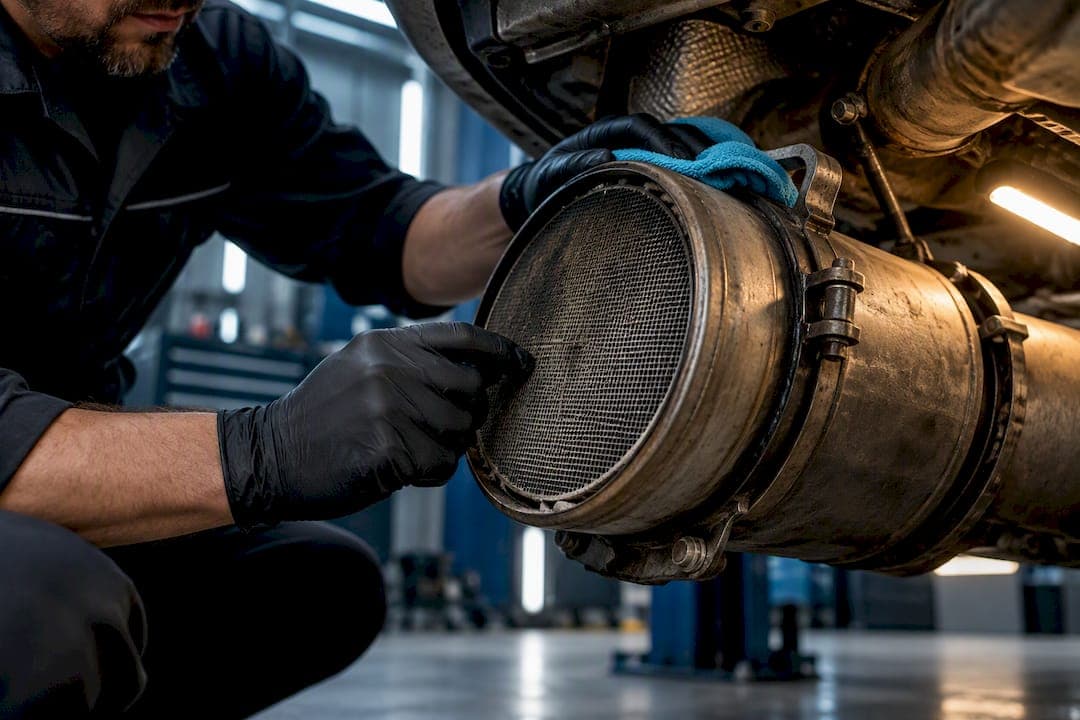
Budget roughly $300 to $900 for a professional DPF cleaning, with full replacement commonly starting around $1,200. Before you pay for either, diagnose first: a code scan, a forced regen attempt, and a flow or backpressure test tell you whether cleaning will actually solve the problem. When those tests show moderate ash buildup and a sound filter, cleaning is usually the better value.
TL;DR:
- Diagnostic tests such as flow measurements and a code scan are essential to determine if cleaning will effectively restore filter function.
- Off-vehicle physical cleaning methods, like thermal bake and ultrasonic cleaning, are the only reliable ways to remove ash buildup, unlike regen or chemical flushes.
- A typical professional DPF cleaning costs between $300 and $900, with heavier or more complex vehicles tending toward the higher end of that range.
- Quotes vary based on filter size, access difficulty, contamination type, and additional services like sensor replacement or gasket kits.
- Replacing the filter is usually more cost-effective than cleaning once physical damage, high ash levels, or costs nearing $900 make cleaning less economical.
Table of Contents
- What Does DPF Cleaning and Replacement Actually Cost?
- Why Do DPF Cleaning Quotes Vary So Much?
- How Do Different DPF Cleaning Methods Compare?
- What Tests Confirm a Clogged DPF Before You Pay?
- When Is Cleaning Worth It Versus Replacing the Filter?
- How Should Fleets Manage DPF Costs and Downtime?
- What Do Real DPF Service Quotes Look Like?
- How Do You Get an Apples-to-Apples DPF Quote?
- Why a Diagnosis-First Approach Matters More Than Price
- Get a Straight Answer on Your DPF Before You Pay for a Fix
- Where These Numbers Come From
- Sources
- FAQ
What Does DPF Cleaning and Replacement Actually Cost?
Professional off-vehicle DPF cleaning typically runs $300 to $900 for light-duty vehicles, covering removal, the cleaning process itself, and reinstallation. Replacement commonly starts above $1,200 and can climb into the thousands depending on whether you choose an OEM or aftermarket filter.
A full quote usually breaks down into a few predictable line items.
- Diagnostics: a code scan and backpressure or flow test, often billed separately from the cleaning itself.
- Labor: removal and reinstallation time, which varies heavily by vehicle layout.
- Cleaning or parts: the physical cleaning charge, or the filter and gaskets for a full swap.
- Extras: new sensors, exhaust clamps, or disposal fees for the old unit.
Cleaning cost ranges from about $300 to $900 depending on vehicle class and labor time, according to current market pricing data. Heavier trucks and vehicles with buried exhaust systems tend to land at the higher end of any range because of the extra labor needed just to access the filter.
Why Do DPF Cleaning Quotes Vary So Much?
Two shops can look at the same filter and give wildly different prices, and it usually comes down to a handful of factors rather than one shop overcharging.
- Labor and access: some vehicles need a cab-off or major exhaust disassembly just to reach the filter, which adds hours before any cleaning starts.
- Filter size and type: larger commercial filters cost more to process and often require new gaskets or clamps.
- Contamination type: soot burns off with regeneration, but ash does not, so a heavily ash-loaded filter needs a more involved method.
- Add-on services: sensor replacement, exhaust gasket kits, and diagnostic retesting after the clean often appear as separate line items.
A quote that skips diagnostics or a post-clean flow test is usually a quote that skipped a step, not one that found a shortcut.
Pro Tip: Ask whether the quoted price includes removal and refit labor, since that’s the line item shops most often leave out of an advertised “starting price.”
How Do Different DPF Cleaning Methods Compare?
Not all DPF services do the same job, and knowing the difference keeps you from paying for a method that won’t fix your actual problem.
- Forced regeneration: a low-cost, quick software-triggered burn that clears soot but does nothing for hardened ash.
- Chemical on-car cleaning: a solvent flush that can loosen light soot deposits but, like regen, cannot remove ash buildup.
- Pneumatic or hydro cleaning: a physical off-vehicle process that forces air or water through the filter to remove ash, sitting at a mid-range cost.
- Thermal bake plus ultrasonic cleaning: the most thorough option, using heat and sound waves to break down hardened ash for close to original flow restoration, at the highest cleaning cost.
Technical guidance on regeneration versus ash removal confirms that only off-vehicle physical methods reliably clear ash, since regen and chemical approaches only address soot.
What Tests Confirm a Clogged DPF Before You Pay?
A trustworthy shop diagnoses before it cleans. Diagnostic trouble codes like P2452 or P2453 often point to a pressure sensor or restriction issue worth confirming before assuming the filter itself is the problem.
- Code scan: identifies sensor faults or confirmed restriction codes.
- Backpressure or flow test: measures actual restriction against the manufacturer’s baseline, both before and after cleaning.
- Borescope inspection: checks for cracks, melting, or substrate damage that cleaning cannot fix.
- Forced regen attempt: a reasonable first step when soot, not ash, appears to be the main cause.
EPA guidance on DPF maintenance recommends monitoring backpressure and running diagnostics before committing to a cleaning service.
When Is Cleaning Worth It Versus Replacing the Filter?
Cleaning makes sense for a mid-life filter with moderate ash loading and no physical damage. Replacement becomes the better call once a filter shows cracking, melting, or ash levels so high that cleaning barely improves flow.
- Mileage and ash fraction: filters accumulate ash gradually, and ash fraction data show that even regularly regenerated units eventually need physical cleaning regardless of mileage alone.
- Substrate damage: visible cracks or melted cells on a borescope mean cleaning will not restore function.
- Price breakpoint: if a cleaning estimate approaches $900 or more, it’s worth comparing directly against a $1,200-plus replacement.
- Warranty: a new filter typically carries a manufacturer or shop warranty, while cleaned units depend on the shop’s own guarantee.
A cleaning quote that creeps close to replacement cost has stopped being the economical choice, based on typical market pricing for both services.
How Should Fleets Manage DPF Costs and Downtime?
Fleet operators face a different equation than individual owners, because downtime often costs more than the cleaning bill itself. A spare-filter exchange program lets a technician swap a clean unit in while the dirty one is processed off-site, keeping a truck on the road.
- Exchange programs: reduce downtime to hours instead of days by swapping pre-cleaned spares.
- On-site versus third-party: an on-site cleaning station suits high-volume fleets, while smaller fleets usually get better value from a trusted outside vendor.
- Downtime math: compare the daily revenue a truck generates against the price difference between a fast exchange and a cheaper but slower cleaning option.
- Recordkeeping: track filter serial numbers and service dates so you can spot units that clog prematurely, which often signals an engine or sensor issue rather than normal wear.
Chapman’s fleet diesel service approach follows this same logic: diagnose the cause of premature clogging rather than cleaning the same filter repeatedly.
What Do Real DPF Service Quotes Look Like?
Seeing sample numbers side by side makes it easier to judge whether a quote you received is reasonable for your vehicle class.
- Light-duty pickup: a forced regen attempt costs little to nothing if successful, while an off-vehicle clean typically lands in the lower half of the $300 to $900 range.
- Medium-duty truck: a pneumatic clean with removal and refit labor sits in the middle of that range, reflecting the extra time needed to access a larger exhaust system.
- Heavy-duty truck: a thermal bake service with possible cab-off labor and longer turnaround pushes toward the top of the range or beyond, depending on filter size.
Cleaning cost typically falls between $300 and $900, according to current market data, with heavier vehicles and more complex access pushing estimates toward the higher end.
How Do You Get an Apples-to-Apples DPF Quote?
A few direct questions on the phone separate a legitimate shop from one guessing at a price.
- Ask for pre- and post-clean flow numbers so you know the test results, not just a promise that the filter will be “better.”
- Confirm what’s included: removal, refit, gaskets, sensors, and any disposal fees should be spelled out, not added later.
- Ask about warranty terms and get any performance guarantee in writing before work begins.
- Watch for red flags: no diagnostics offered, vague language about the process, or a price dramatically below the typical range without explanation.
Pro Tip: If a shop can’t tell you the backpressure reading before and after cleaning, ask how they’re confirming the job actually worked.
Why a Diagnosis-First Approach Matters More Than Price

Chapman’s Automotive has worked on diesel trucks in the Yampa Valley since 1985, and J.B. Chapman represents the third generation of the family in the auto repair business. That history shapes a simple view: a DPF cleaning quote without a diagnostic step is a guess dressed up as a service.
A recurring-clog case usually traces back to a failing sensor or an engine issue causing excess soot, not a filter that keeps failing on its own. Every DPF job at Chapman’s starts with a free digital inspection with photos and a written estimate, so the customer sees the actual backpressure numbers before agreeing to anything, and every repair carries a five-year, 50,000-mile warranty.
— J.B. Chapman
Get a Straight Answer on Your DPF Before You Pay for a Fix
Chapman’s Automotive runs a diagnostic scan and flow test before recommending cleaning or replacement, so you’re paying for a fix that matches what’s actually wrong. Every visit includes a free digital inspection with photos, a written estimate before any work starts, and a free loaner car while your truck is in the shop.

- Same-day diagnostics on Cummins, Power Stroke, and Duramax diesels.
- A written estimate that spells out labor, parts, and warranty terms before you commit.
- Free loaner cars so a DPF job doesn’t take your truck off the road.
Fleet managers and owners in Craig and the surrounding Yampa Valley can request a written quote through Chapman’s diesel repair page and get a real number instead of a rough guess.
Where These Numbers Come From

The cost ranges in this article come from current market pricing data on DPF cleaning and replacement. Technical details on ash accumulation and regeneration come from DieselNet’s technical documentation, and maintenance guidance comes from EPA’s DPF operation bulletin. Readers wanting more detail on the mechanical difference between software-based regen and physical cleaning can also see how shops like FIX-A-DENT describe similar distinctions in physical restoration work.
Sources
- Diesel Particulate Filter Operation and Maintenance (EPA-420-F-10-027)
- DPF Filter Cost Guide: Price Ranges and Budget Tips 2026 – Cost Insider
FAQ
Is a DPF clean worth it?
Cleaning is worth it when diagnostics show moderate ash buildup and no cracking or melting in the substrate. At an estimated $300 to $900, it’s usually cheaper than a $1,200-plus replacement as long as the filter itself is structurally sound.
What are the signs of a clogged DPF?
Common signs include a dashboard warning light, reduced power or sluggish acceleration, and frequent forced regeneration cycles. A code scan often reveals restriction-related codes that point directly to the filter.
Can I clean my DPF myself?
Chemical additives sold for home use can help with light soot buildup, but they cannot remove hardened ash the way professional off-vehicle equipment can. Technical sources confirm that only physical off-vehicle cleaning methods reliably restore flow once ash has accumulated.
Can I drive with a bad DPF?
Driving with a severely clogged or damaged DPF can trigger limp mode, reduce fuel economy, and risk further engine strain. A diagnostic scan and flow test will tell you whether the issue is urgent or can wait for a scheduled service.
Recommended
Questions about your vehicle?
Chapman's Automotive is in Craig, CO — serving the Yampa Valley. Call 970-550-2883 or book online and we'll take a look.