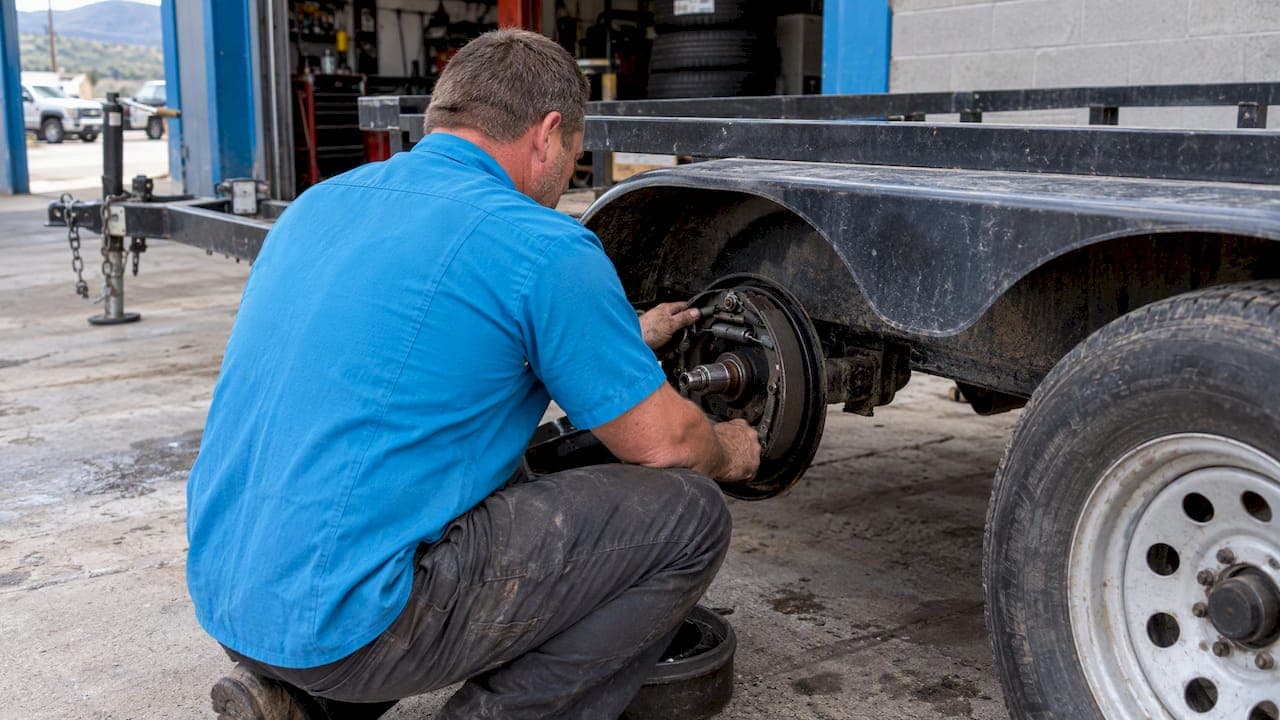
Most trailer owners pay $30 to $135 per wheel for parts-only electric brake repairs, $350 to $600 per axle for a full shop service, and $400 to $1,200 for a brake controller module replacement. Disc brake conversions run higher, often $2,000 to $4,000 or more per axle on heavy-duty setups. Your actual bill depends on brake type, axle rating, and whether wiring work is involved, so a shop diagnostic is still the only way to pin down an exact number.
TL;DR:
- Electric brake parts cost $30 to $135 per wheel, with full axle services typically falling between $350 and $600, and brake control modules costing $400 to $1,200.
- Hydraulic systems can reach $800 to over $3,200 depending on bleeding and fluid work, while disc conversions for heavy-duty trailers can cost $2,000 to $4,000 or more per axle.
- Do-it-yourself work is suitable for replacing shoes and magnets, inspecting wiring, and repacking bearings, but hydraulic and disc system repairs should be left to professionals.
- Symptoms like grinding or locking brakes often require inexpensive parts replacement, while dragging or smoking brakes may indicate significant damage and higher repair costs.
- A shop’s final price depends on brake type, axle count, and diagnostic fees, so asking for detailed estimates and warranties helps prevent unexpected expenses.
Table of Contents
- Cost breakdown by service: parts, labor, diagnostics, and wiring
- Cost expectations by brake system: electric drum, hydraulic, and disc conversion
- Which trailer brake jobs are safe to DIY
- What your trailer’s symptoms say about repair cost
- How shops price trailer brake work and what to ask for
- Chapman’s Automotive: credentials behind this guide
- Why the cheapest quote isn’t always the smartest one
- Get a written trailer brake estimate from Chapman’s
- FAQ
- Sources
Cost breakdown by service: parts, labor, diagnostics, and wiring
Once you know the rough bands, the next question is what you’re actually paying for. Trailer brake invoices break into a handful of predictable line items, and knowing what each should cost helps you catch a quote that’s out of line.
If you’re buying parts for a do-it-yourself job, a shoe-and-magnet kit or complete brake assembly runs $30 to $135 per wheel depending on size and vendor. Budget options, like pre-mounted complete assemblies, can land near the bottom of that range, while OEM Dexter parts tend to sit at $83 to $135 per side.

For shop-installed work, a full axle drum brake service (both wheels, parts and labor combined) typically costs $350 to $600, according to the same RV brake replacement cost guide. One owner-reported example breaks that down as roughly $376 in parts plus $130 in labor for a single axle, landing at $506 total, which tracks closely with the typical range.
Parts vs. labor at a glance:
- Shoe-and-magnet parts kit, per wheel: $30 to $135.
- Full axle service (parts and labor, both wheels): $350 to $600.
- Brake control module, installed: $400 to $1,200.
- Pre-mounted complete brake assembly, per wheel: around $32 on the low end.
A brake control module replacement commonly runs $400 to $1,200 installed, and the spread comes down to module complexity and how much wiring work is involved. A simple plug-and-play module swap sits toward the low end, while a job that requires rewiring a damaged harness or replacing connectors pushes the bill toward the top of that range. Diagnostic fees, when a shop needs to isolate an electrical fault before quoting parts, are usually applied toward the final invoice if you approve the repair, so ask whether that fee is waived or credited before you say yes.
Cost expectations by brake system: electric drum, hydraulic, and disc conversion

The brake type on your trailer changes the whole cost picture, sometimes by thousands of dollars, so it’s worth knowing which one you have before you call for a quote.
Electric drum brakes are the most common setup on utility and cargo trailers, and they’re also the cheapest to maintain. Parts run $30 to $135 per wheel, and a full shop axle service for both wheels typically lands at $350 to $600. These systems use magnets and shoes rather than hydraulic fluid, so there’s no bleeding involved, which keeps labor time down.
Hydraulic brakes, common on motorhomes and some heavier trailers, cost more across the board. Bleeding the lines, flushing old fluid, and the higher cost of hydraulic components add labor hours and parts expense that drum systems don’t carry. Expect a typical range of $800 to $3,200 or more, depending on how many wheel positions need work and whether calipers or wheel cylinders need replacing alongside the pads or shoes.
Disc brake conversions sit at the top of the cost ladder. A light-duty conversion kit for a single 3.5K axle runs $500 to $680 in parts alone, but heavier-duty kits can price out closer to $1,975 per wheel in parts. Once you add installation labor, a tandem-axle conversion on a heavier trailer commonly totals $2,000 to $4,000 or more. Axle weight rating and axle count are the two biggest multipliers here: a single-axle utility trailer converts far more cheaply than a tandem-axle enclosed trailer rated for 7,000 pounds or more.
Quick reference by system type:
- Electric drum: $30 to $135 per wheel (parts), $350 to $600 per axle (shop installed).
- Hydraulic motorhome: $800 to $3,200 or more, driven by bleeding and fluid work.
- Disc conversion, light duty: $500 to $680 in parts per axle.
- Disc conversion, heavy duty, installed: $2,000 to $4,000 or more per axle.
Which trailer brake jobs are safe to DIY
Some trailer brake work is genuinely approachable for a competent weekend mechanic. Other jobs carry enough risk, to your wallet or your safety, that a trained shop is the smarter call.
Tasks that are reasonable to tackle yourself:
- Replacing shoes and magnets on electric drum brakes, using a $30 to $135 parts kit per wheel and roughly one to two hours per side for someone comfortable with a jack and lug wrench.
- Cleaning hubs, inspecting magnets for wear, and checking wiring connections for corrosion before reassembly.
- Repacking wheel bearings during the same service, since the hub is already off.
Tasks better left to a shop:
- Hydraulic brake work, since bleeding the system correctly requires specific tools and experience to avoid a soft or unsafe pedal.
- Disc brake conversions, which involve matching hub bolt patterns, caliper brackets, and axle ratings correctly.
- Brake control module replacement when the wiring itself is suspect, since tracing an intermittent fault without proper testing equipment often leads to replacing parts that weren’t actually broken.
Common DIY mistakes include under-torquing lug nuts and bearing retainer nuts, skipping a proper bleed sequence on hydraulic systems, and reassembling bearings without the correct grease or seal. If you’ve pulled a hub apart and the axle shows scoring, rust pitting, or the brake lines look corroded, stop and get a shop quote rather than pushing forward.
Pro Tip: Always torque your lug nuts in a star pattern and recheck them after the first 50 to 100 miles of towing; a loose wheel is one of the most common and preventable trailer failures.

What your trailer’s symptoms say about repair cost
The symptoms you’re noticing are often a decent clue to how much you’re about to spend, before a shop even looks at the trailer.
- Grinding or scraping noise: usually worn shoes or debris in the drum, typically one of the lower-cost fixes in the $30 to $135 per wheel parts range.
- Brakes grabbing or locking: often glazed shoes, a sticking magnet, or a wiring fault sending too much current, which lands in the moderate range once diagnosed.
- Controller shows “no trailer” or brakes won’t engage at all: frequently a corroded 7-way connector or a poor ground rather than a failed module, which keeps the fix on the cheaper end once found.
- Dragging brakes, smoke, or a hot wheel after driving: a serious symptom that can mean a stuck magnet or seized hub, sometimes requiring a tow and a larger bill.
How shops price trailer brake work and what to ask for
Knowing how a shop builds its estimate puts you in a better position to avoid surprises on the final invoice.
Labor rates for trailer and RV brake work commonly fall in the $100 to $150 per hour range, with some shops reporting figures closer to $125 per hour depending on region and whether the work is urban or rural. A straightforward axle service might run one to two labor hours, while a module replacement with wiring diagnostics can run longer. Diagnostic fees are typically charged to isolate an electrical issue before a shop quotes parts, and many shops apply that fee toward the repair if you move forward.
When you call for a quote, have these details ready:
- Brake type (electric drum, hydraulic, or disc) and axle rating.
- Single axle or tandem, and how many axles need service.
- Symptoms you’ve noticed, plus photos of the hub or wiring if you have them.
- Whether you want OEM or aftermarket parts, since pricing and availability differ.
| What to ask for | Why it matters |
|---|---|
| Written estimate | Confirms parts, labor hours, and total before work starts |
| Parts brand options | OEM vs. aftermarket can shift price significantly, based on reported module replacement pricing |
| Labor warranty | Protects you if the same issue returns shortly after service |
| Parts warranty | Covers defective shoes, magnets, or modules separately from labor |
Chapman’s Automotive: credentials behind this guide
We’ve put together these figures from published cost guides and from what we see at the counter every week. Chapman’s Automotive has operated in Craig, Colorado since 1985, and this article comes from J.B. Chapman, the fourth generation of his family in the Yampa Valley and the third generation to run the shop.
Here’s what backs up the advice above:
- We handle trailer and RV repair alongside full brake diagnostics for electric, hydraulic, and disc systems.
- Every visit includes a free digital inspection with photos before approving work.
- We offer same-day diagnostics and loaner cars, so a brake inspection doesn’t mean losing your trailer or your vehicle for days.
- Repairs carry a warranty covering the work long after you’ve left the shop.
Why the cheapest quote isn’t always the smartest one
The conventional advice on trailer brakes treats every job like a commodity: get three quotes, pick the lowest number, move on. That misses the bigger cost driver, which isn’t the invoice total but the diagnosis behind it. A $400 module replacement is a waste of money if the real problem is a corroded 7-way connector that a five-minute cleaning would have fixed. A $350 axle service is a bad deal if the shop skipped checking the magnets and you’re back in six months.
What we’d prioritize first isn’t the lowest bid, it’s a shop willing to explain what’s actually worn versus what’s precautionary, and to put that in writing before touching a wrench. Electric drum brakes are forgiving and cheap to maintain if you stay ahead of wear. Hydraulic and disc systems punish deferred maintenance much harder, in both dollars and downtime. Budget accordingly, and don’t let a bargain quote talk you out of asking what, specifically, is being replaced and why.
— J.B. Chapman
Get a written trailer brake estimate from Chapman’s
We know towing season doesn’t wait, and neither should a brake inspection. When you call us, we’ll walk through your brake type, axle rating, and symptoms, then give you a written estimate backed by a free digital inspection with photos, so you know exactly what you’re paying for before we start.

Here’s what helps us get you an accurate number fast:
- Photos of the hub, wiring, or anything visibly worn or corroded.
- Your axle rating and whether you’re running a single or tandem axle.
- A quick description of the symptoms, grinding, dragging, or a controller fault.
Every repair we complete carries a warranty, and we offer loaner cars and a shuttle if your trailer needs more than a same-day turnaround. Visit our trailer and RV repair page to schedule, or check our auto repair cost guide for more pricing examples before you call.
FAQ
How often should trailer brakes be changed?
Most electric trailer brake shoes and magnets last several years of normal towing, but inspection intervals matter more than a fixed replacement schedule. Check them at least once a year or whenever you notice grinding, grabbing, or uneven wear, since catching a worn magnet early keeps you in the lower end of the $30 to $135 per wheel parts range.
What is a reasonable price for a brake job?
For electric drum trailer brakes, a reasonable shop price for a full axle service, both wheels, parts and labor, falls in the $350 to $600 range. Hydraulic or disc-conversion jobs cost considerably more because of added labor and parts, so compare quotes within the same brake system type rather than across different ones.
What does it mean when it says “service trailer brakes”?
A “service trailer brakes” warning on your tow vehicle’s dash usually points to an electrical fault, often a corroded 7-way connector or a poor ground, rather than worn-out brake components. It’s worth checking the connector and ground before assuming you need a new controller module.
Does a 3,500 lb trailer need brakes?
Brake requirements for trailers depend on your state’s weight threshold, and many states require brakes on at least one axle once a trailer’s gross weight reaches a certain point. Check your state’s specific rule before towing, since requirements vary and getting it wrong can mean a citation or a liability issue.
Sources
- RV Brake Replacement Cost: What to Expect in 2026
- Common Brake Controller Issues While Towing a Cargo Trailer | Neighbors Trailer
Recommended
Questions about your vehicle?
Chapman's Automotive is in Craig, CO — serving the Yampa Valley. Call 970-550-2883 or book online and we'll take a look.